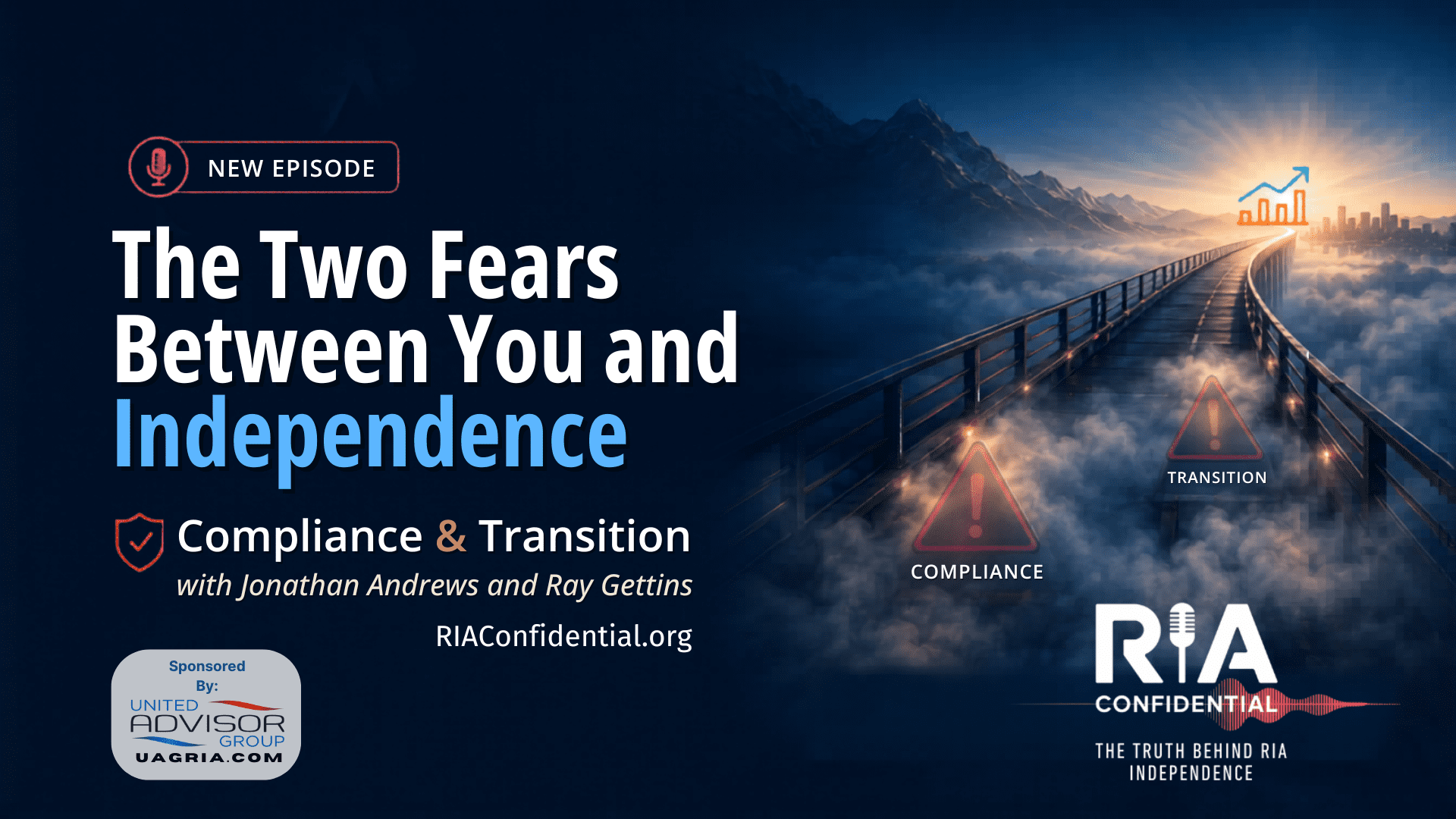
00:00 — Introduction: The Two Biggest Fears
Jonathan introduces the episode’s focus on the two major obstacles that stop advisors from pursuing independence: compliance and transition.
00:58 — Why Advisors Feel Stuck
Ray explains that many advisors are not opposed to independence itself — they are intimidated by the perceived complexity of compliance and transition.
02:20 — Compliance as the First “Bogeyman”
The hosts discuss why compliance is commonly associated with restriction, limitation, and friction inside traditional environments.
03:23 — Reframing Compliance
Ray shares a new perspective: good compliance is infrastructure that helps create stronger, more defensible businesses rather than suppressing growth.
05:02 — Separating Bad Experiences from Reality
The conversation explores how advisors often project negative compliance experiences from one environment onto every future opportunity.
06:12 — Compliance and Growth Can Coexist
Ray explains why flexibility, innovation, and compliance are not mutually exclusive when the right systems and support exist.
07:15 — Transition Fear Takes Over
Jonathan shifts the discussion to transition anxiety and the emotional picture many advisors create around moving to independence.
08:31 — Transition Is a Process, Not a Catastrophe
The hosts break down transition into manageable stages including planning, communication, coordination, and sequencing.
09:34 — What Advisors Usually Get Wrong About Transition
Ray outlines the three biggest misconceptions: overestimating chaos, overestimating cost, and overestimating disruption.
11:21 — The Emotional Side of Transition
The discussion turns to identity, certainty, routines, and the emotional fears advisors carry when considering a move.
12:35 — Clarity Reduces Fear
Ray explains why more time alone does not reduce fear — clarity and visibility into the process do.
13:03 — Why These Fears Create Paralysis
Compliance triggers fear of risk while transition triggers fear of disruption, creating hesitation that can last for years.
13:46 — The Hidden Cost of Staying Put
The hosts discuss the often-overlooked cost of remaining in a limiting structure versus the visible cost of change.
16:20 — Preview of a One-Week Transition Case Study
Ray previews next month’s episode featuring a real advisor transition completed in one week with minimal out-of-pocket expense.
17:40 — Visibility Over Mythology
The episode closes with the idea that transparency, evidence, and real examples help replace fear with understanding.
[00:11] Ray: Thanks, Jonathan. Good to be here.
[00:14] Jonathan: Today we’re talking about two things that stop a lot of advisors from seriously exploring independence.
[00:58] Ray: A lot of advisors are not sitting there saying, “I do not want independence.” What they’re really saying is they do not know if they can get through the compliance side or the transition side.
[01:29] Jonathan: Independence sounds appealing in theory, but compliance and transition make the move feel intimidating and distant.
[01:52] Ray: The fear around compliance and transition is often larger than the reality when advisors have the right support and structure.
[02:07] Jonathan: Today we’re pulling these fears out of the shadows and discussing why they keep advisors stuck.
[02:18] Ray: Once people can see the process more clearly, a lot of the emotional weight starts to come off.
[02:20] Jonathan: Let’s start with compliance — the first big fear advisors usually bring up when considering independence.
[02:42] Ray: Many advisors associate compliance with restriction, delays, and limitations instead of support.
[03:11] Jonathan: Advisors often assume compliance will become even harder if they go independent.
[03:23] Ray: Good compliance should help build a stronger, more defensible business — not shut one down.
[03:55] Jonathan: Many advisors have only experienced compliance as friction and resistance.
[04:20] Ray: The conversation changes when advisors ask how to build correctly instead of asking whether compliance will stop them.
[04:41] Jonathan: What do you say to advisors whose experience has taught them that compliance kills flexibility?
[05:02] Ray: A bad experience with compliance does not mean every compliance framework has to feel bad.
[05:36] Jonathan: Some advisors project painful experiences from one environment onto every future environment.
[05:45] Ray: Advisors need to separate the concept of compliance from the environment where they experienced it.
[06:00] Jonathan: Otherwise advisors may blame the future for issues tied to a previous structure.
[06:12] Ray: Growth and compliance are not opponents. The right compliance setup can actually support growth.
[06:35] Jonathan: The real issue is whether compliance is treated as a partner in building the business.
[06:50] Ray: The right people change the conversation from hearing “no” to asking how to structure and support growth.
[07:02] Jonathan: Compliance loses power as a fear once advisors realize it does not have to be the enemy.
[07:11] Ray: Compliance matters, but it does not have to be the monster advisors imagine.
[07:15] Jonathan: Transition is the second major fear, and it becomes emotional very quickly.
[07:42] Ray: Advisors often picture transition as one giant storm where everything goes wrong at once.
[08:13] Jonathan: Fear makes people stop seeing steps and only see chaos.
[08:31] Ray: Transition is not one giant mess — it is a process involving planning, coordination, timing, and support.
[08:59] Jonathan: Careful does not mean catastrophic, even though many people treat them the same way.
[09:10] Ray: Advisors often overestimate transition chaos and underestimate how much planning can simplify the process.
[09:34] Jonathan: What are advisors usually getting wrong about transition?
[09:47] Ray: Advisors overestimate the chaos, cost, and disruption while underestimating available help and sequencing.
[10:19] Jonathan: Many advisors fear transition like a giant mystery bill with no itemization.
[10:34] Ray: Real transitions are made up of manageable moving parts, not one giant event.
[11:02] Jonathan: Even well-managed transitions can still sound emotionally exhausting for advisors.
[11:21] Ray: Transition is emotional because it affects identity, routine, certainty, and familiarity.
[11:54] Jonathan: Sometimes practical concerns are actually emotional fears hiding underneath.
[12:06] Ray: Once advisors acknowledge both the practical and emotional sides of transition, they can address both honestly.
[12:21] Jonathan: Some advisors do not need more time — they need more clarity.
[12:35] Ray: Clarity reduces fear more effectively than waiting.
[12:43] Jonathan: The goal is not to pressure advisors into moving but to help them make grounded decisions.
[12:48] Ray: Exactly right.
[12:50] Jonathan: Why do compliance and transition keep advisors stuck for so long?
[13:03] Ray: Compliance triggers fear of risk while transition triggers fear of disruption, creating paralysis.
[13:39] Jonathan: Sometimes that hesitation lasts for years.
[13:46] Ray: Many advisors calculate the imagined cost of moving but ignore the real cost of staying stuck.
[14:18] Jonathan: People often measure the visible cost of change without measuring the hidden cost of delay.
[14:32] Ray: The cost of staying stuck may be less visible, but it is still very real.
[15:04] Jonathan: Staying in place can become a drift problem instead of an intentional decision.
[15:18] Ray: Drift feels safe short term but can become very costly over time.
[15:38] Jonathan: This show exists to help advisors move beyond myths and assumptions into honest conversations.
[15:53] Ray: Exactly.
[16:20] Jonathan: Next month’s episode will focus on a real advisor transition case study.
[16:34] Ray: The case study will show how one advisor completed a transition in one week with almost no out-of-pocket cost.
[17:22] Jonathan: The episode will also include a written case study breakdown.
[17:40] Ray: Visibility helps reduce fear by replacing assumptions with understanding.
[18:24] Jonathan: Encouragement is good, but evidence is better.
[18:42] Ray: The goal is not to oversell transition but to show the reality is often less frightening than the mythology.
[19:20] Jonathan: Compliance and transition fears may be real, but they may not be as big as they seem.
[19:38] Ray: The right compliance structure, transition plan, and guidance can make independence much more manageable.
[19:58] Jonathan: RIA Confidential exists to help advisors ask better questions and gain a clearer view of independence.
[20:14] Ray: Visit RIAConfidential.com and subscribe for next month’s case study episode.
[20:43] Jonathan: The goal is to make compliance and transition more understandable and less mysterious.
[21:06] Ray: I’m Ray Gettins.
[21:10] Jonathan: And I’m Jonathan Andrews. We’ll see you next time on RIA Confidential.
RIA Confidential is expanding from a podcast-only experience into a full independence Resource Hub. The show stays the flagship voice, but the platform becomes the infrastructure: stage-based pathways, tools, roadmaps, and an organized library that reduces guesswork for advisors at every phase.
This is not a rebrand. It is a structural and governance shift designed to protect trust, transparency, and editorial independence long-term.
Your launch point for independence. Pick your stage (Exploring, Planning, Executing) and get matched to the right resources and tools. The mission is simple: reduce guesswork and move you forward with clean information.
Build Your Independence Plan.
The operational backbone. A vendor-neutral sequence built to prevent avoidable mistakes across four phases:
Decide: Clarify the destination and validate economics
Plan: Manage constraints like contracts, Protocol posture, and timing
Build + Launch: Client segmentation and daily execution tracking
Transition + Run: Compliance reset and a 30/60/90 cadence
Interactive tools that convert uncertainty into decisions. Built to help you compare scenarios, quantify tradeoffs, pressure-test readiness, and get next steps that connect to messaging, planning, and execution checklists.
An organized command center for independence. Start by stage, then go deeper by topic: client transition, economics, custody and platforms, deal terms, and more. Plain-English guidance, practical checklists, and curated hubs.
A weekly intelligence brief focused on structural shifts shaping advisor independence: custody movement, compliance expectations, recruiting pressure, capital, deal activity, and the real-world landscape.
Send your real story from inside the system: what pushed you toward independence, what surprised you, what you wish you knew earlier.
Not an information problem. An incentive problem. Advisors get stuck when they cannot tell what is true or neutral.
Rules are public, disclosures are non-negotiable, and sponsors do not influence editorial topics or conclusions.
Yes. The tools are designed to be publicly useful without forced opt-ins.
To protect the mission long-term through governance, transparency, and durability, especially in a space where money changes incentives.
Use the Confidential Question Box or send a Signal Drop. The point is to let advisors participate without risking reputational blowback.
RIA Confidential Resource Hub: Guidance on Going Independent. Support to Scale.
Practical tools, clear paths, and real-world playbooks for advisors exploring independence, or making independence work.