
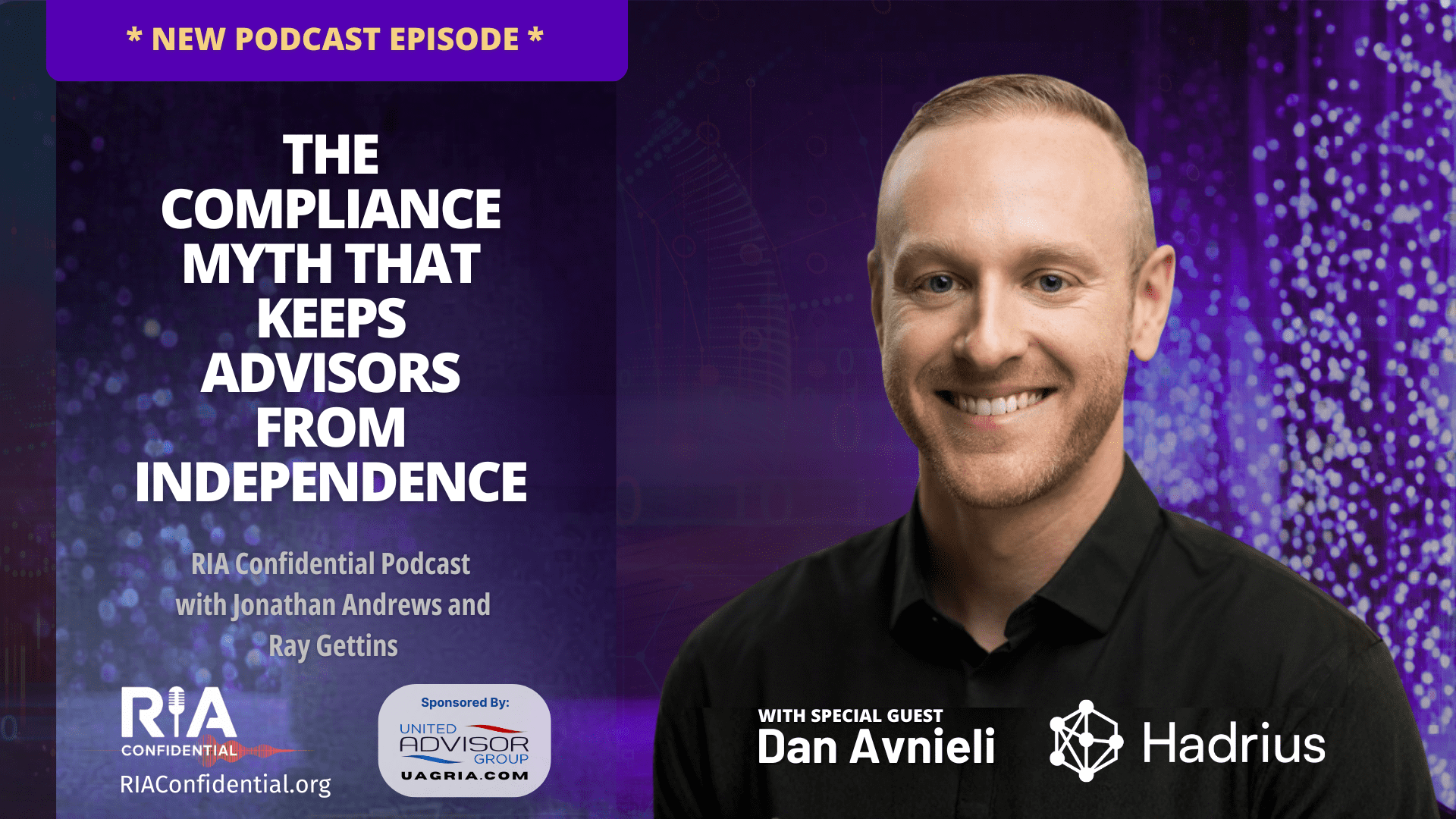
00:00 – Introduction to RIA Compliance
Overview of the episode and why compliance is a major concern for advisors transitioning to the RIA model.
01:00 – Why Compliance Feels Intimidating
Discussion on fear stemming from FINRA experience and misconceptions about SEC oversight.
02:00 – Inside the RIA Compliance Framework
Introduction to practical strategies from industry experts on building compliance systems.
05:00 – SEC vs FINRA: Key Differences
Why SEC compliance is often less rigid and more principles-based than FINRA.
06:24 – Building a Compliance System
Breaking down compliance into people and technology components.
08:00 – Choosing the Right Tools & Support
How advisors can decide what to outsource vs handle internally.
09:34 – Avoiding Over-Reliance on Vendors
Why advisors should customize their compliance setup instead of buying everything.
10:33 – Debunking Compliance Myths
Why compliance shouldn’t stop advisors from launching their RIA.
12:00 – Time Management & Growth Focus
How to minimize time spent on compliance and prioritize business growth.
13:43 – The Shift to Integrated Platforms
Why the future of compliance lies in all-in-one systems instead of fragmented tools.
14:41 – Final Takeaways & Action Steps
Key lessons on building a scalable, efficient RIA compliance framework.
Advisors evaluating advisor independence should also review guidance from the U.S. Securities and Exchange Commission and FINRA to better understand registration, supervision, and compliance expectations.
[00:00:00] [Jonathan]
Welcome to RIA Confidential, your source for the truth about going RIA. I’m your host, Jonathan Andrews, with BraveHearts TV Network, here to explore the questions and concerns financial advisors have about transitioning to the RIA business model.
This episode uses AI in production, created from human-created dialogue. We’re excited to be embracing the use of AI and look forward to your feedback.
With that being said, let’s dive in.
Today we’re pulling back the curtain on compliance and what it really takes to build it out properly as an RIA. I’m joined by my co-host, Ray Gettins. Ray’s a 30-year veteran in financial services, the Executive Director at RIA Confidential, and known as the RIA Mentor, having helped many, many financial advisors make the leap to independence.
[00:01:00] [Jonathan]
Welcome to the show, Ray.
[00:01:02] [Ray]
Thanks, Jonathan. Great to be here.
[00:01:04] [Jonathan]
Today we’re getting into a topic that can make even experienced advisors tense up a little bit: compliance.
[00:01:10] [Ray]
Yeah, and for good reason. For a lot of advisors coming out of the wirehouse world or the independent broker-dealer channel, compliance has been something that felt rigid, intimidating, and at times like a constant roadblock.
[00:01:24] [Jonathan]
Especially when you’re thinking about making the move to the RIA model. There’s this assumption that once you leave the FINRA world and move into the SEC world, you’re stepping into something complicated, risky, and overwhelming.
[00:01:38] [Ray]
Yeah. But the truth is that fear is often bigger than the reality.
[00:01:44] [Jonathan]
Okay, okay. Let’s dig into that a bit. Ray, you recently sat down live at RIA Edge in Nashville with Daniel Elli from Hadrius to talk through what advisors really need to understand when they’re building an RIA compliance framework.
[00:02:00] [Ray]
Yeah, and what I liked about this conversation is that it gets practical. We’re not just talking theory. We’re talking about what changes when you move from FINRA to SEC oversight, what a real compliance system should look like, when to rely on people, when to rely on technology, and how to avoid making compliance the thing that stalls your growth.
[00:02:23] [Jonathan]
That’s the key, because if compliance becomes the monster in your mind, it can keep you stuck. But if you understand it, organize it, and build the right support around it, it becomes something you can manage with confidence.
[00:02:37] [Ray]
Exactly. So in this interview, listen for a few important ideas. First, why the SEC framework may actually be less intimidating in practice than many advisors expect. Second, why compliance is really a combination of people and systems. And third, why the right consultant and the right platform can save you a tremendous amount of time and friction.
[00:03:00] [Jonathan]
For those of you who are somewhere between “I’m thinking about breaking away” and “I’ve already launched, but now I want to tighten up what I’ve built,” this conversation is specifically for you.
Okay, let’s get into it. Here’s Ray’s conversation with Dan from Hadrius. And for our listeners who aren’t familiar, Hadrius specializes in making SEC and FINRA compliance effortless. Let’s listen now to that conversation.
[00:03:25] [Ray]
This is Ray Gettins with the RIA Confidential podcast. We are actually recording this podcast live from RIA Edge in Nashville, Tennessee. Super excited to have our guest on today, Dan Elli with Hadrius Compliance.
Dan, thanks for joining me today, and please take a moment to introduce yourself.
[00:03:46] [Dan]
Perfect. Thank you for having me, Ray. As you already mentioned, my name is Dan. I was part of the founding team here at Hadrius. We have an all-in-one compliance solution, so really our goal is that you can just have one compliance vendor and then manage your entire compliance program and not even need to think about it anymore.
So excited to chat with you and excited to get started.
[00:04:12] [Ray]
That sounds too good to be true, my friend.
[00:04:15] [Dan]
A lot of people definitely say that. That’s why we’re working towards it.
[00:04:19] [Ray]
We’re working towards it. All right. Hey, a couple of things. I know myself and many of the other advisors that we’ve talked to over the years started in the wirehouses or the independent broker-dealer channel or what have you. In other words, it’s a fancy way of saying they’ve been playing under FINRA rules for 10, 15, 20-plus years.
And I know for a lot of folks it’s almost, for lack of a better term, a culture shock comparing FINRA to SEC. Give me the true “here’s where we’re seeing differences, here’s why it does feel like a culture shock.” Give me some background on that, if you would.
[00:05:00] [Dan]
Yeah, yeah. I’ll give a quick disclaimer that I’m not a CCO, and so anyone who’s making decisions, you should talk to the CCOs involved.
But what I can say is that we’ve helped hundreds of firms either break away from the wirehouse world or actually just be able to set up their entire compliance program. And the difference between the SEC and FINRA ends up coming down specifically to the business that you’re trying to build and the kind of talent that you have in-house.
Historically speaking, FINRA is actually a lot more strict than the SEC. And so just to give you a quick example, for communication archiving, one of the requirements inside of FINRA is that you do a certain percentage of archiving, while the SEC doesn’t have these same types of requirements.
And so while it can feel very daunting to move over to the SEC side of the world, I think that it’s actually more daunting in theory than in actual practice. Really, at the end of the day, the SEC wants to make sure that people have reasonable processes in place, and that’s what they’re setting this up for.
[00:06:00] [Ray]
Some good news on that piece then. I guess the other piece that comes to mind is, once we realize that there is this difference, now we want to put in place a true system. Because I think we all understand that anytime you can eliminate the manual aspect of anything, you significantly reduce the errors.
So talk to me a little bit about a compliance system. Talk to me a bit about that.
[00:06:24] [Dan]
Yeah. At the end of the day, you can think of compliance in terms of two things. One is people, and the other is software.
And so when you’re actually setting up a new compliance function, one of the main things that I always recommend is: are you going to be taking on these responsibilities entirely in-house, or would you like some help with a compliance consultant who can handle it?
You really only have three options. You wear the hat and you do everything yourself. You wear the hat and you hire someone else to do it. Or you outsource it completely and they handle the entire operation.
For new RIAs or anyone setting up their compliance program for the first time, I always recommend going the middle route. A good starting point, or a good rule of thumb, is you wear the CCO hat, but you work with a consultant to be able to help with a lot of the day-to-day functions.
Does that make sense?
[00:07:00] [Ray]
Oh, it makes a world of sense. I’ll even chime in one piece that I’ve had conversations about. You go back to that coming from the FINRA world, going to the SEC world, that the right compliance consultant, the right people, can help you even create a much better, more succinct, more professional investment advisory agreement and the other paperwork that you need.
Otherwise, it’s going to look clunky, and it’s going to be something that just screams, “All right, this is what I learned from FINRA,” and it doesn’t fit, doesn’t apply. You create an advisory agreement that’s designed for cats when you’re now a dog.
So spot on. Makes a world of sense.
All right, so let me take a step back on something you mentioned as far as putting this compliance system together. Having it all under one roof — that makes a world of sense. But do I have to go that route? What if I have some things I do want, or say I have a more sophisticated system and I don’t need everything that might come with the package? Talk to me about how that works and how that looks.
[00:08:00] [Dan]
I think it’s a benefit analysis in terms of what you feel comfortable doing and the technology that you’re currently using.
And so before I fully answer that question, I’ll talk about the tech for a second. With the SEC or FINRA, there are certain requirements that you need to be held against. One of them is going to be WORM-compliant storage, making sure that any of your communication channels with clients is being archived into a place.
But what it ends up coming down to — should I outsource this to the consultant, should I handle this in-house — is how are you actually dealing with that? How are you actually putting this into practice?
And some vendors are using AI. Everyone’s talking about AI, but there are certain use cases where AI can do the job to be done. It can get the process down. And so paying a consultant to do your email archiving in the future probably makes less sense, but still doing your filings probably makes a lot more sense.
And so it depends on what tech you’re using and what you feel comfortable actually doing in your day-to-day practice.
[00:09:00] [Ray]
So when I look at this, I have to balance. I have to know — or I have to have someone that tells me so that I do know — what the SEC is going to be looking for.
Dan, it almost sounds like I’m teaching to the test. So if I know, “Hey, I’ve got to be archiving my emails, I’ve got to be archiving texts if I’m going to do texting,” and just go down the list, those are the kinds of things that I can come to you and say, “All right, I need a system to do this. I want A and B, maybe not C, maybe C next year.” You and I have that conversation, we can actually build that thing out.
[00:09:34] [Dan]
Yes. Yeah, exactly. And one of the best approaches that I take is a compliance consultant is going to give you from A to Z every single thing that they offer. And then you can actually ask them to send that to you after the call. And then you can take a fine-grain comb and go through it and say, “Hey, I feel comfortable doing X, Y, and Z, but these are the things that I really need help with.”
I mean, of course when you hop on the call, it’s in everyone’s best interest to be able to say, “Yeah, you need us for every single thing,” but a lot of times you actually don’t, and especially with the right tech, you really don’t.
And so focusing on the areas where you need the most amount of support and the most help is a really good starting point. And then you can always add more services over time.
But my goal is: you have a dream of being able to build your RIA — do not let compliance be the limiting factor there. You can set this up, you can talk with the right people, and find the right partners to help you through this process. Compliance should not be the bottleneck in terms of starting your business.
[00:10:33] [Ray]
So it’s not the boogeyman.
[00:10:35] [Dan]
No, it’s definitely not the boogeyman. As much as everyone will joke about compliance, again, I know that it can seem a little cliché, but the SEC’s entire goal is to protect clients, to protect people from bad actors. And most of the people who are thinking about starting another firm are not bad actors, so they have nothing to worry about if they’re not doing anything illegal.
That said, there are certain checkboxes that you need to be able to check to stay compliant with the SEC, and most of those can be put on one page, and it should not be very daunting.
[00:11:08] [Ray]
Terrific. Well, Dan, that’s been our experience. That’s been the conversations I’ve had. They go back to right where we very first started, which is to put in place a compliance system.
Talk to the folks that have been through audits. The SEC is looking for systems. They understand the same thing, same place we started at. The more you do manual, the more likely it is for something to slip through the cracks.
Okay. Wrap me up this way. What’s the best advice you can give? What’s the one thing that people overlook? Give me something that is just, from your experience of talking to either RIAs that are just launching or the folks that are going, “All right, now it’s for real. Hey, we’re a year into this and now we see the things that are keeping me awake at night.” Give me a couple perspective pieces on that.
[00:12:00] [Dan]
Yeah. First I would say that with the right technology and the right consultant, compliance is something that you should be spending a very little bit of your time doing. You should be focused on growth. And at the end of the day, building a great business requires actually being able to grow.
And if you’re spending all of your time on compliance, then you’re actually not adding to the bottom line, which is growing your business.
And so if you feel confident enough that you have all of the things in place to be able to build the business, the last of your concerns should be the compliance function saying, “Hey, I can do everything. I can do all the hard parts, but I can’t actually do the compliance.” That can be solved. And that can be solved either internally by talking with the right folks and hiring the right people, or using a consultant. And then either way, using the right tech.
We’ve all been playing around with AI. I know that it becomes the big buzzword nowadays. But many times it can actually solve problems that you don’t even realize are problems until after the fact. For example, email surveillance — something that two years ago required a ton of energy and a ton of time — now can be mostly automated using AI. There’s still a human in the loop, but it can be done mostly using AI.
So again, the hard part is growing the business. If you feel confident about growing the business, compliance should be the last thing that you should be worrying about in actually getting your footing and bringing yourself into market.
[00:13:24] [Ray]
I guess the other piece you mentioned before — so you’ve got people and you’ve got systems. Some of the best compliance people are looking for some of the best systems. So it’s not where they’re going to be resistant to the idea of working with Hadrius, because you are looking at one of the best, most advanced systems out there right now.
[00:13:43] [Dan]
And one of the other things that I would add is that in this future world, I think point solutions don’t make sense anymore. I think that platforms make sense. And the real difference there is that you should be able to consolidate as many functions into one platform as possible, whether that’s your compliance or your sales org or whatever it might be.
And so with Hadrius, being able to consolidate as much as possible into one platform and then use the right technology to lift up previous inefficiencies has been a huge game changer.
And so ask more of your vendors. Ask more of the tooling that you’re using, because right now there’s this golden age of opportunity in terms of amazing tools, and you just might not even know they exist.
[00:14:18] [Ray]
Very cool. Dan, once again, I appreciate you taking the time to talk with us today. Once again, everyone, live from RIA Edge here in Nashville. And Dan, once again, thanks for taking some of the mystery out of what is no longer a boogeyman — compliance. So thank you. Appreciate your time this afternoon.
[00:14:39] [Dan]
Thank you, Ray.
[00:14:41] [Jonathan]
Thanks, Dan. Wow, that was a strong conversation. Dan really broke it down for us.
[00:14:47] [Ray]
Yeah, and I think one of the biggest takeaways is this: compliance is not supposed to be the reason you do not move forward. It needs to be respected, but not mythologized.
[00:14:59] [Jonathan]
Exactly. Advisors can build this. They can do it well. But the mistake is thinking they have to either figure out every moving part alone or buy into an oversized, one-size-fits-all solution without understanding what they actually need.
[00:15:15] [Ray]
That was one of my favorite parts — the idea that the answer is not always outsource everything, and it is not always do everything yourself. There’s often a smarter middle ground.
[00:15:27] [Jonathan]
Yes. And that’s what Hadrius does so well for advisors and frankly why we’ve partnered with Hadrius. They are just excellent at helping advisors parse exactly which systems and technology they need, so advisors get just the right amount of help carrying the load.
That applies beyond compliance too. It’s really a bigger lesson about building an RIA the right way — not by cobbling everything together manually, not by overcomplicating it, but by creating a structure that is defensible, efficient, and scalable.
[00:16:00] [Ray]
That’s it. If your entire business is running on manual effort, eventually something gets dropped. And when it comes to compliance, that is not where you want avoidable friction showing up.
Another point that stood out was the role of technology. A lot of firms are still thinking about compliance tools as static or disconnected point solutions, but that model is starting to age fast.
[00:16:21] [Jonathan]
It is, and what Dan was getting at is important. The future belongs to better integrated platforms — systems that do more, reduce duplication, and help firms stay organized without adding more administrative burden.
[00:16:35] [Ray]
That matters because advisors should be spending their best energy on growth, client experience, and building a stronger firm, not drowning in preventable operational drag.
[00:16:46] [Jonathan]
Exactly. Compliance is super critical, and Hadrius simplifies it to the point that it actually supports growth instead of suffocating it, as we’ve seen with firms that try to do everything manually on their own.
Again, great conversation. And if you’re listening as an advisor thinking about independence, or if you’ve already made the leap and want to sharpen your infrastructure, this is the kind of conversation worth paying attention to. And it’s worth a moment to check out the support Hadrius can bring to your operation.
[00:17:18] [Ray]
To find out more, go now to riaconfidential.org/hads. Again, that’s riaconfidential.org/hads.
While you are at our site, riaconfidential.org, checking out our sponsor Hadrius, be sure to look around at the many resources there, including the RIA Calculator, articles, podcast episodes, and other tools designed to help advisors think more clearly and move more confidently.
And if this episode sparked a question for you, or made you realize you may be closer to independence than you thought, take the next step. Learn more, run the numbers, and keep the conversation going.
[00:17:56] [Jonathan]
Thanks for joining us on RIA Confidential. We’ll see you next time.
[00:18:03] [Disclaimer]
The investment strategy and themes discussed herein may be unsuitable for investors depending on their specific investment objectives and financial situation. Information obtained from third-party sources is believed to be reliable, though its accuracy is not guaranteed. Opinions expressed in this commentary reflect subjective judgments of the authors based on conditions at the time of publication and are subject to change without notice.
Past performance is not indicative of future results.
RIA Confidential is expanding from a podcast-only experience into a full independence Resource Hub. The show stays the flagship voice, but the platform becomes the infrastructure: stage-based pathways, tools, roadmaps, and an organized library that reduces guesswork for advisors at every phase.
This is not a rebrand. It is a structural and governance shift designed to protect trust, transparency, and editorial independence long-term.
Your launch point for independence. Pick your stage (Exploring, Planning, Executing) and get matched to the right resources and tools. The mission is simple: reduce guesswork and move you forward with clean information.
Build Your Independence Plan.
The operational backbone. A vendor-neutral sequence built to prevent avoidable mistakes across four phases:
Decide: Clarify the destination and validate economics
Plan: Manage constraints like contracts, Protocol posture, and timing
Build + Launch: Client segmentation and daily execution tracking
Transition + Run: Compliance reset and a 30/60/90 cadence
Interactive tools that convert uncertainty into decisions. Built to help you compare scenarios, quantify tradeoffs, pressure-test readiness, and get next steps that connect to messaging, planning, and execution checklists.
An organized command center for independence. Start by stage, then go deeper by topic: client transition, economics, custody and platforms, deal terms, and more. Plain-English guidance, practical checklists, and curated hubs.
A weekly intelligence brief focused on structural shifts shaping advisor independence: custody movement, compliance expectations, recruiting pressure, capital, deal activity, and the real-world landscape.
Send your real story from inside the system: what pushed you toward independence, what surprised you, what you wish you knew earlier.
Not an information problem. An incentive problem. Advisors get stuck when they cannot tell what is true or neutral.
Rules are public, disclosures are non-negotiable, and sponsors do not influence editorial topics or conclusions.
Yes. The tools are designed to be publicly useful without forced opt-ins.
To protect the mission long-term through governance, transparency, and durability, especially in a space where money changes incentives.
Use the Confidential Question Box or send a Signal Drop. The point is to let advisors participate without risking reputational blowback.
RIA Confidential Resource Hub: Guidance on Going Independent. Support to Scale.
Practical tools, clear paths, and real-world playbooks for advisors exploring independence, or making independence work.