
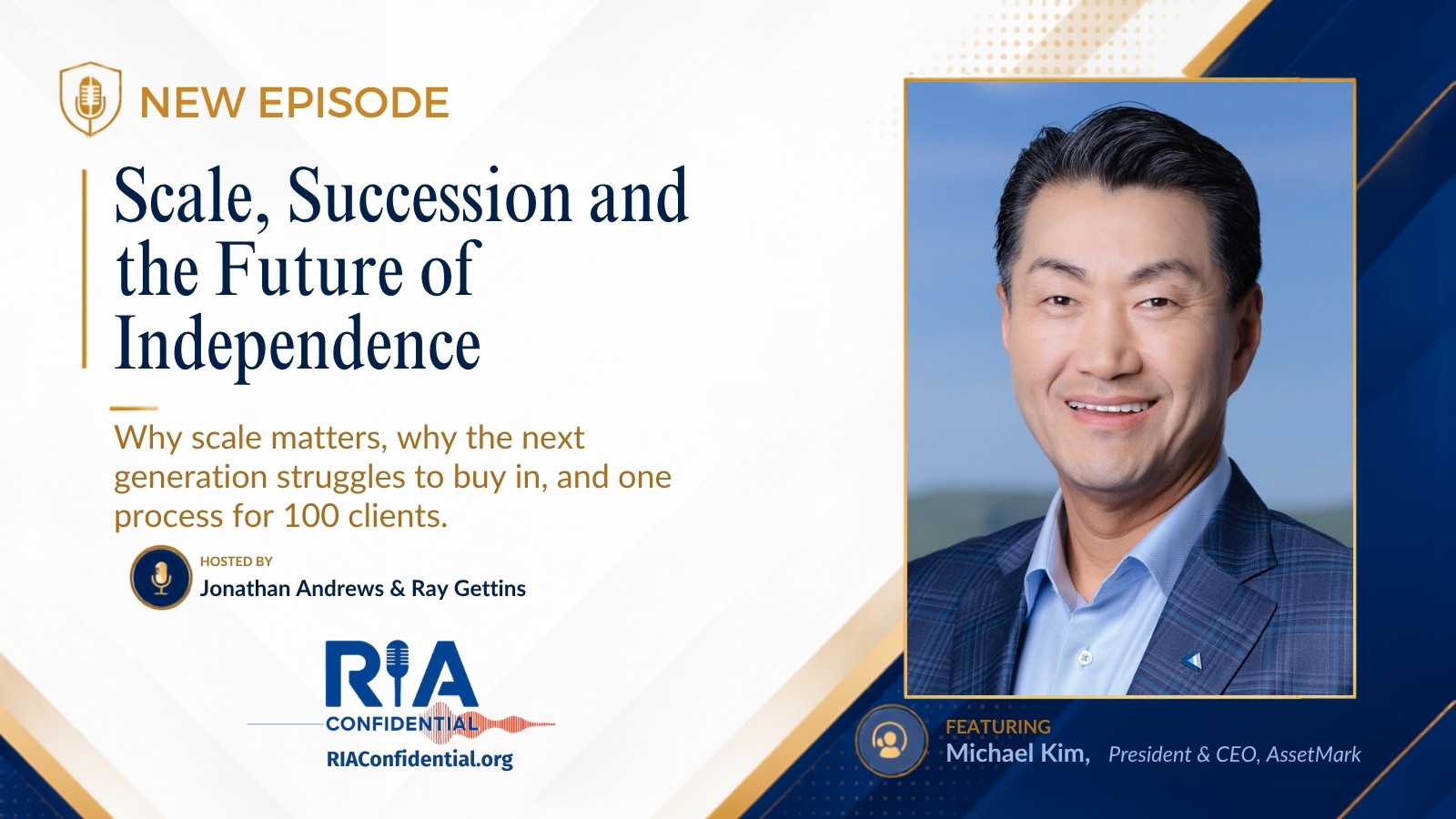
[00:11] Jonathan: Welcome to RIA Confidential, your source for the truth about going RIA. I’m your host, Jonathan Andrews with BraveHeartsTV Network, here to explore the questions and concerns financial advisors have about transitioning to the RIA business model. And joining me is RIA Confidential founder Ray Gettins. Ray, good to have you back.
[00:31] Ray: Good to be here, Jonathan.
[00:32] Jonathan: I want to start this one with something pretty simple. Everybody wants growth. More clients, more assets, more revenue, a more valuable business. But at some point growth creates another question: who’s going to take over and own this thing next?
[00:45] Ray: Yeah, and that’s one of the things that really stood out to me in my conversation with Michael Kim, the president of AssetMark, who we’re going to hear from shortly. Building value is one thing. Building a business that somebody else can eventually step into, and own, and continue growing is something else entirely.
[01:05] Jonathan: Yes, and ironically, the more valuable the firm becomes, the harder that transition can get.
[01:11] Ray: Right. Because now the younger advisor who might be perfect to eventually take over may not be able to afford to buy in. Michael talks about that directly. The next-generation advisor may want equity, they may want skin in the game, and the founder may absolutely want to create that opportunity.
[01:28] Jonathan: Yes, but if the value of the firm keeps climbing…
[01:31] Ray: You’ve got to be intentional about creating a path for that next generation to participate in ownership over time.
[01:37] Jonathan: Then you get into consolidation, outside capital, broker-dealers, asset managers, valuations. And Michael keeps coming back to one phrase.
[01:48] Ray: Scale matters. And here’s what I found really interesting. Michael isn’t saying every firm has to become enormous.
[01:55] Jonathan: Yes, yes.
[01:56] Ray: He talks about this barbell, where the largest firms may continue getting bigger, but there’s still room on the other end for really differentiated boutique firms that have created an experience, a specialty, or maybe a community the larger firms can’t easily replicate. So if you’re somewhere in the middle, that probably forces a pretty important question.
[02:19] Jonathan: Absolutely.
[02:21] Ray: If you’re not going to win on sheer size, what are you going to be known for?
[02:25] Jonathan: Exactly.
[02:26] Ray: Yeah, and I think that’s a question every advisor should probably be asking.
[02:29] Jonathan: Okay. Before we jump into the conversation, what should people listen for? What are your thoughts?
[02:35] Ray: First, Michael’s comments about succession and ownership, especially what happens when the value of the firm starts making ownership harder for the next generation. Second, what he means when he says scale matters. And third, toward the end, there’s a very simple point about serving 100 clients with one process instead of 101.
[02:59] Jonathan: Great stuff. All right, let’s get into it. Here’s Ray’s conversation with Michael Kim, President and CEO of AssetMark.
[03:08] Ray: Michael Kim, thank you so much for sitting down with me before the AssetMark Leaders Summit. Tell me a little bit about the Leaders Summit before we get started.
[03:17] Michael: Yeah. Thank you, Ray. Great to be here with you. I’ve been with AssetMark for 16 years now, and the last four years as president and CEO. About six years ago, we launched this group called the Leaders Summit, and it’s specifically intended to create a community of the leaders of OSJ firms, corporate RIAs, general agencies for those folks that are affiliated with insurance companies, and other producing groups.
One of the things that we saw, Ray, was that a lot of our broker-dealer partners were doing so much great work, more at the macro level. And we saw an opportunity in the great work that these enterprise leaders were doing to serve advisors, support advisors, and create a community for these advisors. So why not us at AssetMark? Also to be a partner behind the scenes to support these leaders who are creating these wonderful communities for their advisors. That’s really how we got started, and we’ve been doing this for about six years now.
We absolutely believe that this is the wave of the future. We know that advisors are out there doing incredible work for their clients, and they need a partner, a partner to help not only with their practice growth, but really with delivering that elegant experience to their clients. We’re just thrilled to be a part of this wonderful community, where we get to help those leaders that are helping advisors.
[04:49] Ray: All right, well, let me ask you a couple of questions. I’m thrilled with the idea of you having a unique perspective on things. Let’s talk a little bit about the industry for a moment. A lot of advisors tune into the podcast, and they want to hear, “What else is going on while I’m minding my clients?” So a couple of things. M&A. Keep on going? Same rate? Faster? More? We’ve got momentum. Tell me what M&A is going to look like. Look in your crystal ball for me.
[05:19] Michael: Yeah. So I saw a report the other day that said there were over 500 RIA transactions in 2025 alone that were above, I want to say, at least a billion dollars. It’s mind-boggling [check], not only the size, but the volume and the pace of these transactions.
A lot of times we get the question, what’s causing that? What are the drivers? And I think there are a few different factors your audience should think about. One is, as we talked about earlier, the aging of the clients. Well, the advisors and the demographics are also contributing to this consolidation.
[06:03] Ray: Yeah, we know the rule. The average advisor is within 10 years of the average age of their client.
[06:08] Michael: Right, right. So there you go. And depending on which studies you look at, Cerulli, I think, quoted over 100,000 advisors retiring in the next 10 years. So think about that. There’s a lot of talk about succession planning, et cetera. I think it’s actually a crisis. It is a succession crisis. Think about this: there are over 100,000 advisors retiring over the next 10 years. That’s a third of the industry.
[06:39] Ray: That sounds like a brain drain.
[06:41] Michael: Exactly. And where my head goes is, what happens to the clients when there’s this exodus of these great advisors?
[06:48] Ray: Well, let me ask you a question. You mentioned you’re working with thousands of advisors. How many of them are truly taking the junior advisor seriously, or bringing in the heir apparent? Or are they just kind of punting that down the road and not taking the advice they’re giving to their clients? What’s your sense on that?
[07:07] Michael: Look, I think many advisors are bringing in either family members or other junior advisors to be that next generation serving their clients. And I do believe that, if managed properly, that’s a great transition opportunity. At the same time, I think there has to be much more of an intentional focus on it, and on creating the right structures to enable that.
Many times the next-gen advisors actually want to buy into the firm, have equity ownership, participate and have skin in the game. But because valuations are so high, they just can’t afford that level of skin in the game.
[07:57] Ray: Interesting.
[07:58] Michael: So part of the structural component is to figure out a pathway where the next-gen advisors can slowly but intentionally buy in or participate in the firm’s growth, to drive the alignment, and ultimately for there to be a continuity plan to take care of the clients throughout the lifetime of the clients.
[08:19] Ray: Well, the other piece to look at is even just the pure training that has to be involved there. Traditionally, if we look back, where did advisors come from? Large firms that had very formal training programs. That doesn’t necessarily mean they were perfect, but it at least got you from A to B to C to D.
[08:39] Michael: That’s right. It’s the training, the onboarding, really instilling a sense of confidence in the next group of advisors to engage with the clients and deliver that confidence in terms of their financial goals. We’re talking about people’s livelihoods here, so we want to make sure advisors are properly trained and ready to serve the clients properly. That’s an important part of it.
The other factor that I think is important to mention, more from a business point of view, besides the demographics and the aging of the advisors, is that there’s a lot of capital coming into this industry. I think a lot of people have heard of the private equity effect, or other institutions coming in. We believe the wealth management industry continues to be very attractive to these institutional investors. They love the continued demand for advice. They love the economic model, meaning the recurring revenue stream. They love the fact that this is arguably one of the most noble professions, and advice will always be in demand.
I think part of the consolidation trend we’re talking about here is also fueled by a lot of the capital coming into our industry, and we believe that’s going to continue. So the key headline, Ray, is that we believe the consolidation pace and trend is going to continue over the next several years.
[10:17] Ray: All right. So on one hand we have this capital coming in. We all understand Econ 101, supply and demand. If we’ve got this huge supply coming in, we know what that’s going to do to price. You talked a minute ago about how it makes it much tougher for the junior advisor to buy in. How do we solve that problem? Is there even a solution for that problem yet?
[10:38] Michael: There are many different approaches. Whether it’s the best solution or not [check], there are different types of equity incentive plans, or ESOP-type plans, as examples of vehicles and structures that will enable the next generation to slowly but intentionally buy into the firms.
[11:02] Ray: Well, I can see that making sense, because in almost all of the private equity deals that I’ve seen with RIAs, part of the value is keeping the key players in place. So if that stays there, I think that does give you a shot at putting something together that allows the next generation to get that equity.
All right, so we talked a little bit about RIAs. I think that bleeds a little bit into the independent broker-dealer channel. Are we still thinking there’s going to be as much acquisition there? And the other one that I think gets really overlooked is the investment management firms. We look at a lot of the small and mid-size firms out there, and I imagine part of it’s an age demographic as well. Are we thinking the same kind of consolidation there as well?
[11:47] Michael: Yes. Let’s start with the broker-dealers, and we’ll go to the asset management firms. On the broker-dealer front, all of the factors we talked about on the RIA front also apply. But one other theme that applies to RIAs, and certainly to the broker-dealers, is the element of scale. Scale matters. And again, let me repeat: scale matters. And again, scale matters.
[12:13] Ray: So you’re saying scale matters.
[12:14] Michael: Scale matters, exactly. If you canvass the independent broker-dealer landscape, we all know the larger firms. And the reason they’re able to consolidate and acquire the mid-sized firms is because they’re bringing that level of scale to those firms. So scale matters. And we believe it’s going to be the classic barbell scenario, where the larger firms will continue to get bigger, and on the other end of the barbell will be the boutique, specialized firms that have created a certain unique community and experience that can’t be replicated by these larger firms. So we’ll see that barbell effect, and we believe the independent broker-dealer space will continue to go through a certain level of consolidation.
On the asset management front, I think it’s a similar story in terms of the demographics and the scale element. Part of it is also thinking about distribution. Distribution matters. Scale matters, as we just talked about, and distribution also matters. The firms that have recently gone through transactions aren’t only great investment management firms; they also have very unique distribution channels, resources and outlets. That’s one of the key things the buyers will be looking for.
[13:51] Ray: And so valuation on those, okay.
[13:53] Michael: Exactly.
[13:54] Ray: So it’s an interesting… well, let me ask you this question on the independent broker-dealer side. So far, I guess we could classify most of it as vertical. Does it start to get more horizontal?
[14:05] Michael: That’s a very good question. I think there’s still some room to go on the vertical before they have to be more creative and go horizontal.
[14:12] Ray: Exactly.
[14:13] Michael: And that’s my own personal opinion. I could see certain firms going a little bit wider from a horizontal perspective, but I think there’s still some meat on the bones in terms of the vertical alignment.
[14:24] Ray: Because what runs through my head is the classic Netflix idea, or Apple. Apple starts with phones, they dabbled in cars, now they have their own film content, things of that nature.
[14:35] Michael: Now, one of the other things that we’ll be keeping a close eye on is, as these firms continue to develop scale, and factoring in the demographics we just talked about, some of the firms are now starting to entertain adjacent markets, meaning things like W-2 models.
[15:00] Ray: I’ve noticed that. You’ve started to see that come back again. It was like, “No, no, no.” And now it’s like, “Well, maybe there is.” Is some of that based on the demographics? Because we hear that different generations look at the entrepreneurial side of financial services differently than other generations.
[15:20] Michael: The demographics are a huge part of it. Certain advisors reach a point in their career and their life cycle where they want to continue to serve clients, but they may also have more of a lifestyle consideration. It’s a matter of being more of an advisor only and less of a business owner. That’s where the W-2 model comes into play, and it’s a program that really meets their expectations.
[15:51] Ray: Interesting.
[15:52] Michael: The other element here is that W-2 advisors are part of the independent model. And, how do I say this, it feels and sounds like a bit of a contradiction, because this industry was developed and started by individuals who were fiercely independent. But there’s also a belief that one’s affiliation status and compensation model doesn’t necessarily define the level of independence. So it’s a very fascinating debate.
[16:28] Ray: You can uncouple the two.
[16:29] Michael: That’s a great point.
[16:30] Ray: Yeah, because I think we’ve run into that: “You can’t be independent if you’re a W-2, because you’re beholden to the paycheck.”
[16:37] Michael: That’s right. So it’s going to be an interesting movie to watch, to borrow your Netflix analogy.
[16:46] Ray: Well done. Okay, terrific. Looking at the RIAs you mentioned, the bigger sales, are we seeing those primarily rolling into aggregators? And the follow-up to that: give me the perspective from AssetMark. Are there advantages and disadvantages of the aggregator versus the one-man shop?
[17:09] Michael: On the first part of your question, many of the deals are being done by the aggregators, simply because they can bring scale and, generally speaking, higher valuations. Now, one of the things we always talk about with advisors who may be contemplating those types of proposals and packages is: read the fine print [check]. There are certain growth expectations embedded in those valuations and the offers they get. So really understand the fine print, and make sure you know and feel comfortable with the growth expectations.
From AssetMark’s point of view, first and foremost, we’re a service provider. We’re not in the business of acquiring advisors. We work with many different firms, enterprise partners that are in that business, and we support them from a platform point of view. But to be clear, we’re not in the business of acquiring advisors. That’s what our clients do, and we leave that up to them.
Having said that, given the number of advisors we support, we do get to see various types of transactions and the trends out there. A couple of things are accretive, not just to valuation, but to creating more of that curb appeal, as I like to say, for the advisor’s practice.
First and foremost, have a consistent process for serving clients. If you have 100 clients, make sure you have one process, not 101 processes. That’s why, going back to the advisor-as-portfolio-manager type of model [check], we believe they should outsource, because that offers, by definition, a consistent service model and process to take care of clients, as opposed to a more individualized approach.
Number two, fee-based revenue, advisory revenue, versus, say, commission revenue or 12b-1 revenue. It generally carries a higher valuation.
[19:27] Ray: Oh, yeah.
[19:28] Michael: So one of the things we talk to a lot of advisors about is, let’s help you strategically position your business. That’s a fancy way of saying, let’s help you go to advisory. Many advisors have legacy 12b-1, annuities, maybe certain portfolios they’re just managing on the side. Let’s help the advisors get the house in order so that it’s mostly advisory, if not all advisory, and there’s a consistent and common process to serve clients. That’s usually a good tailwind toward healthier valuations. Those are some of the conversations we have.
And lastly, maybe just as a plug for AssetMark, we have a team of, in my opinion, the best business consultants in the industry, who work closely with advisors to help them think through these types of important issues. And most importantly, they’re an accountability agent. We’re like the fitness instructor: we not only go to the gym with them, we help them do the reps. We hold them accountable.
[20:38] Ray: There you go. There you go. Beautiful.
[20:41] Michael: Yeah. Whether you want to show up or not, you’ve got to show up, because you’re waiting for me. [check] That’s our… [check] We actually start off every single one of our internal and external meetings with the mission and the values. Our mission simply is to make a difference in the lives of advisors and their clients, and that pretty much governs everything we do. The “how” part is: every single day, put the clients at the center of our universe, and do everything with heart, integrity, respect and excellence, and always bring success to the clients. Those values govern everything we do. Ray, I’ve been with the firm for 16 years, and I love this company, I love our clients, I love what I do, and these values remind me of the importance of what we do. Hopefully we’re making a difference.
[21:35] Ray: Agreed, agreed. You mentioned it’s a noble profession, and I remember talking to a gentleman a few years back. His point was: if we do this well, we impact not just one generation, but multiple generations.
[21:49] Michael: That’s right. That’s right.
[21:51] Ray: That’s as noble as you can get.
[21:52] Michael: That’s right.
[21:53] Ray: So thank you. Appreciate it.
[21:54] Michael: Thank you. That was fun.
[21:56] Jonathan: All right, we’re back. Ray, I want to start with a huge point Michael made. Scale matters. What did you take that to mean?
[22:03] Ray: I’d say scale isn’t automatically about having more employees or becoming one of the biggest firms in the country. To me, it’s about whether the business can handle more without everything becoming harder. Can you add clients without adding too much chaos or complexity? Here’s a good benchmark: can someone else step into the process easily? And can the business keep functioning without every decision having to come back through the founder? That’s where my head goes. Because you can absolutely grow without becoming more scalable, right?
[22:33] Jonathan: Oh, absolutely.
[22:34] Ray: You can have more revenue, more assets, more clients, and still have a business that’s harder to operate than it was five years ago.
[22:43] Jonathan: Which brings us to that line near the end. 100 clients. One process.
[22:47] Ray: Not 101. That’s it. And I think that’s such a good gut check. If you’ve got 100 clients, how many different process customizations does it take to actually serve those 100 clients?
[23:01] Jonathan: Now, I want to be careful here, because nobody’s saying the advice shouldn’t be personal.
[23:05] Ray: Not at all.
[23:06] Jonathan: For sure.
[23:07] Ray: The advice should absolutely be personal. The relationship should be personal. But the process underneath that relationship doesn’t need to be reinvented every single time. And that starts to affect everything: your ability to train somebody, your ability to delegate, your ability to bring another advisor into the relationship, your ability to grow, and eventually your ability to transition the business.
[23:33] Jonathan: That’s the part that really jumped out to me, because now this isn’t just an operations conversation.
[23:39] Ray: Exactly. It becomes a succession conversation. If everything lives in the founder’s head, then when it’s time for somebody else to step in, you’ve got a problem. You don’t really have a succession plan.
[23:50] Jonathan: You have a person.
[23:51] Ray: Right. And that’s where I think advisors can get themselves into trouble. They may already have somebody in mind. Maybe it’s a son or daughter. Maybe it’s a younger advisor on the team.
[24:01] Jonathan: Yes.
[24:02] Ray: But having the person isn’t the same thing as having the pathway.
[24:05] Jonathan: Right.
[24:06] Ray: How are they going to learn the business? How do they build relationships with the clients?
[24:11] Jonathan: Yes.
[24:12] Ray: And how do they participate financially? How do they gradually earn or buy into equity? Those are things you probably want to solve before the transition becomes urgent.
[24:22] Jonathan: And there’s a fascinating problem underneath that. The better the founder does at building the value of the business, the more expensive it becomes for the next person to buy.
[24:32] Ray: Exactly. It’s one of those good problems that can become a very real problem if you don’t plan for it. Michael talks about intentionally creating structures that allow the next generation to participate over time, rather than expecting somebody to show up one day and suddenly write an enormous check.
[24:48] Jonathan: Okay, but let me push on something else. There’s an interesting part where you and Michael start talking about W-2 advisors and independence. On the surface, those things almost sound like they shouldn’t go together.
[25:01] Ray: Yeah, I thought that was fascinating. Historically, we tend to tie independence to ownership or compensation structure, right?
[25:07] Jonathan: Yeah, right.
[25:08] Ray: And to Michael’s point, those things may be able to come apart.
[25:11] Jonathan: Absolutely.
[25:12] Ray: You can have somebody who wants to spend their time advising clients and wants a level of independence in how they work, but doesn’t necessarily want all the responsibility that comes with owning and operating the business.
[25:24] Jonathan: Which brings us back to something you talk about all the time. What do you actually want?
[25:29] Ray: Exactly. Do you want to own the business? Do you want to manage people? Do you want equity?
[25:36] Jonathan: This is where it’s at.
[25:37] Ray: You have to know your own goals. Do you mostly want to advise clients? Do you want lifestyle flexibility? There isn’t one right answer. But I think you’re a lot better off making that decision intentionally than waking up one day and realizing you built a job you didn’t actually want.
[25:52] Jonathan: 100%. Okay, let’s go back to Michael’s barbell for a second. The biggest firms keep getting bigger, but he also says there’s room for the boutique firm that has something the large firm can’t easily reproduce.
[26:04] Ray: Right. And I think smaller firms should actually find that encouraging. You don’t necessarily have to win by being the biggest, but you probably do need to know what makes you different. What do you do unusually well? Who are you unusually good at serving? What experience have you built? If you’re not going to win because you’re the biggest, you’d better know why somebody chooses you.
[26:28] Jonathan: Exactly.
[26:29] Ray: And then the next question becomes, what do we really need to build ourselves, and where does it make more sense to bring in a partner?
[26:35] Jonathan: Which is where AssetMark comes into this naturally. I thought Michael was very clear that AssetMark isn’t trying to acquire the advisory firm.
[26:42] Ray: Yes, he makes that distinction very clearly. They’re a service provider. Their role is supporting firms with the platform, resources, investment capabilities and business consulting they need. And I liked his last point about the business consultants.
[26:58] Jonathan: The fitness instructor?
[26:59] Ray: Exactly. Because we all know knowing isn’t doing.
[27:03] Jonathan: That’s right. Doing the reps is [check]…
[27:06] Ray: And having somebody there saying, “Nope, you said you were going to do this. We’re doing it.”
[27:11] Jonathan: Anybody who’s run a business understands that one. So let’s bring this home. Advisors listening right now have heard the conversation. Where do you start?
[27:20] Ray: I’d start with one question. If your firm doubled in size tomorrow, what would break down first? Don’t overthink it. Just go with what came into your head. Was it your people? Maybe your processes, client service, investment management, technology? Or the fact that every decision still has to come back through you? Whatever answer showed up first is probably worth paying attention to. And then I’d add one more: if you weren’t there five years from now, could somebody else actually run what you’ve built?
[27:51] Jonathan: Yeah, that’s the real question, right?
[27:53] Ray: Right. Because growth is one thing. Building something that can continue without you is something else entirely.
[27:58] Jonathan: Well said. Okay, that’s a wrap for today. If you’d like to dig deeper into some of the issues Ray and Michael discussed today, including outsourcing, succession and practice growth, we’ve included related AssetMark resources in the show notes and in the AssetMark section of the RIA Confidential Resource Center. And if this conversation raised questions about your own growth, succession plan, operating model, or what independence should look like for you, don’t wait [check] until the decision becomes urgent. Start asking the questions now. And remember, you can find this episode and more resources for independent advisors at riaconfidential.org.
Thank you for listening, and thank you to our guest, Michael Kim, President and CEO of AssetMark and Champion Sponsor of RIA Confidential, our nonprofit resource center and podcast. And if you know another advisor who should hear this conversation, send it their way. We’ll see you next time.
[29:04] The investment strategy and themes discussed herein may be unsuitable for investors depending on their specific investment objectives and financial situation. Information obtained from third-party sources is believed to be reliable, though its accuracy is not guaranteed. Opinions expressed in this commentary reflect subjective judgments of the authors based on conditions at the time of publication and are subject to change without notice. Past performance is not indicative of future results
RIA Confidential is expanding from a podcast-only experience into a full independence Resource Hub. The show stays the flagship voice, but the platform becomes the infrastructure: stage-based pathways, tools, roadmaps, and an organized library that reduces guesswork for advisors at every phase.
This is not a rebrand. It is a structural and governance shift designed to protect trust, transparency, and editorial independence long-term.
Your launch point for independence. Pick your stage (Exploring, Planning, Executing) and get matched to the right resources and tools. The mission is simple: reduce guesswork and move you forward with clean information.
Build Your Independence Plan.
The operational backbone. A vendor-neutral sequence built to prevent avoidable mistakes across four phases:
Decide: Clarify the destination and validate economics
Plan: Manage constraints like contracts, Protocol posture, and timing
Build + Launch: Client segmentation and daily execution tracking
Transition + Run: Compliance reset and a 30/60/90 cadence
Interactive tools that convert uncertainty into decisions. Built to help you compare scenarios, quantify tradeoffs, pressure-test readiness, and get next steps that connect to messaging, planning, and execution checklists.
An organized command center for independence. Start by stage, then go deeper by topic: client transition, economics, custody and platforms, deal terms, and more. Plain-English guidance, practical checklists, and curated hubs.
A weekly intelligence brief focused on structural shifts shaping advisor independence: custody movement, compliance expectations, recruiting pressure, capital, deal activity, and the real-world landscape.
Send your real story from inside the system: what pushed you toward independence, what surprised you, what you wish you knew earlier.
Not an information problem. An incentive problem. Advisors get stuck when they cannot tell what is true or neutral.
Rules are public, disclosures are non-negotiable, and sponsors do not influence editorial topics or conclusions.
Yes. The tools are designed to be publicly useful without forced opt-ins.
To protect the mission long-term through governance, transparency, and durability, especially in a space where money changes incentives.
Use the Confidential Question Box or send a Signal Drop. The point is to let advisors participate without risking reputational blowback.

RIA Confidential Resource Hub: Guidance on Going Independent. Support to Scale.
Practical tools, clear paths, and real-world playbooks for advisors exploring independence, or making independence work.