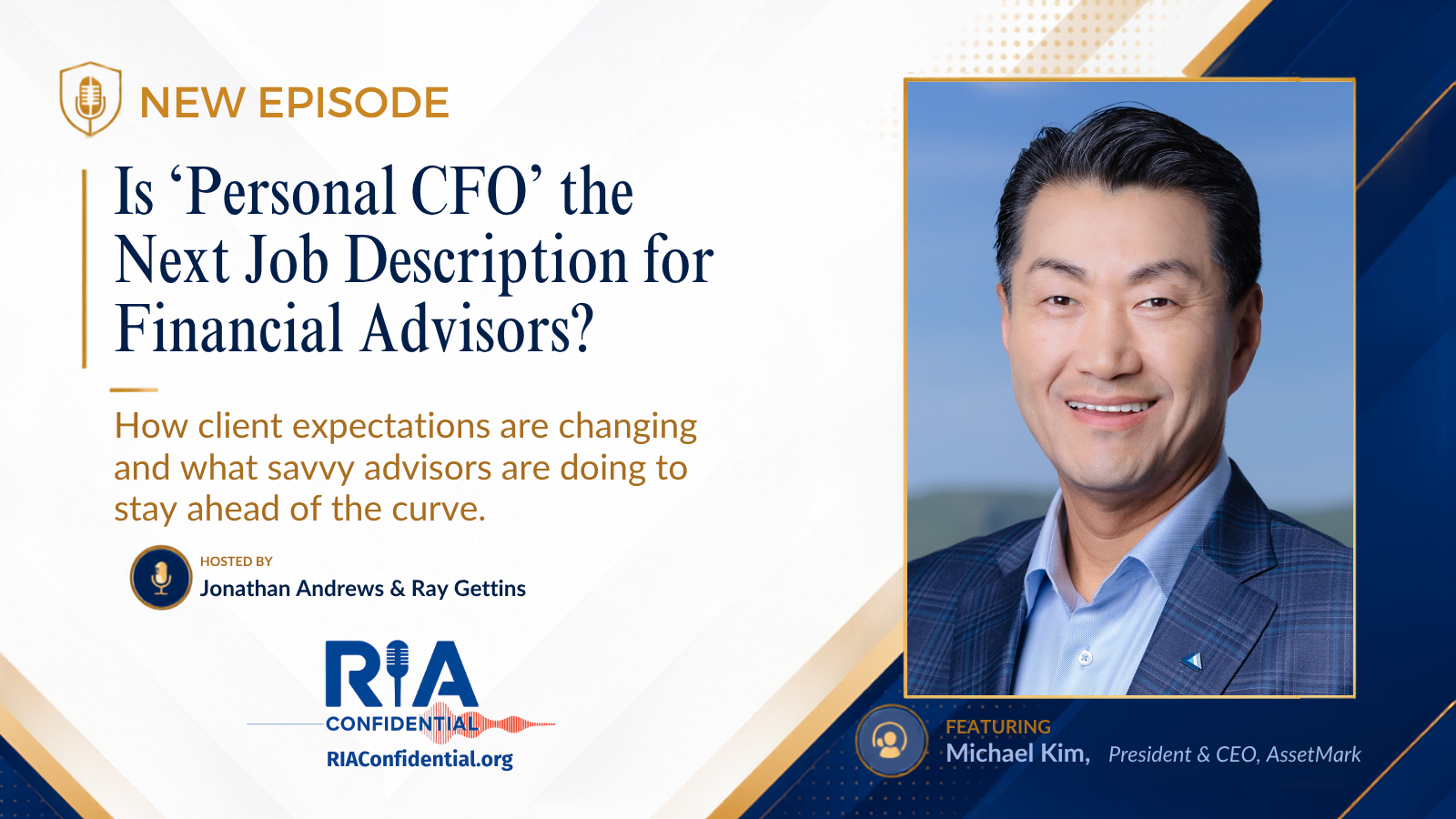
Clients increasingly want more than investment management. In this episode, Jonathan Andrews and Ray Gettens explore the growing role of the advisor as a personal CFO—helping clients connect investments, tax, estate planning, business decisions, and broader family wealth.
The conversation features Michael Kim, President and CEO of AssetMark, on how advisors can meet these changing expectations without trying to become every specialist themselves.
What could more capacity make possible?
As clients expect more from their advisor, where you spend your time matters more than ever.
AssetMark helps advisors reduce the time and complexity of investment management with institutional investment expertise, turnkey portfolio solutions, trading and operational support, and technology designed to streamline day-to-day work.
AssetMark is a Champion sponsor of RIA Confidential.
00:00 Welcome to RIA Confidential
01:29 What Kind of Advisor Do Clients Need?
03:10 Inside the Conversation with Michael Kim
06:33 What Trends Should Advisors Be Watching?
07:47 What Are Clients Expecting?
08:42 The Rise of the Personal CFO
09:31 Why Investment Management Alone May Not Be Enough
10:14 Becoming the Steward of the Client’s Entire Wealth
12:06 From Family Office to Personal CFO
13:52 Building a Network of Expertise
15:29 Why the Opportunity Is Growing Now
16:28 Leadership, Values, and the Future of Advice
18:19 What the Personal CFO Role Really Means
19:57 Why Client Complexity Is Increasing
21:18 How Advisors Can Build More Capability Without Doing Everything Themselves
Personal CFO” the Next Job Description for Financial Advisors
[00:00:00] Jonathan Andrew:
Welcome to RIA Confidential, your source for the truth about going RIA. I’m your host, Jonathan Andrews, with Brave Hearts TV Network, here to explore the questions and concerns financial advisors have about transitioning to the RIA business model. This episode uses AI in production created from human-created dialogue.
[00:00:31] We’re excited to be embracing the use of AI and look forward to your feedback. With that being said, let’s dive in. Welcome to RIA Confidential, your source for the truth about going RIA. I’m your host, Jonathan Andrews, and once again, I’m joined by my co-host and RIA expert, Ray Gettens. Ray, welcome back.
[00:00:49] Ray Gettins:
Thanks, Jonathan. Glad to be here. So, you know, last month we spent a lot of time talking about what happens after an advisor makes the move to independence. Um What kind of firm are you actually building? Who’s gonna do what? Where does technology fit? What should your team own? And somehow we ended up spending a surprising amount of time talking about Tuesdays.
[00:01:08] Ray Gettins:
We did. Well, well, Tuesday tells the truth. Everybody can design a beautiful business on a whiteboard. Then, um, Tuesday morning shows up, somebody needs something, the technology isn’t cooperating, three clients call at once. That’s when you find out what you actually built. There it is, and that conversation led us to another question.
[00:01:29] Jonathan Andrews:
Let’s say you’ve thought carefully about the firm, you’ve built the structure, you’ve got more control. Now, now what kind of advisor do your clients need you to become? Yeah, and I, I think that’s where this gets really interesting because if the answer is, “I’m going to do everything exactly the way I’ve always done it just with a different logo,” then sooner or later Tuesday is going to look exactly the same as always.
[00:01:51] Yeah, we see that fairly often. Yes, too often. So today we’re highlighting something extra special because you recently had a chance to sit down with someone who sees a lot of this from a pretty unusual vantage point.
Ray Gettins: Yes. Yes, I had the great opportunity to sit down with Michael Kim, president and CEO of AssetMark during the AssetMark Leader Summit, and, uh, we covered a lot.
[00:02:13] Jonathan Andrews:
Um, but one part of the conversation really fits where we left off in our last episode. You were talking about the client. What are clients asking for now? How is the advisor’s role changing, and what do they increasingly expect from the person sitting across the table from them?
Ray Gettins: Right, and I think personal CFO is a pretty good way to describe where this is heading, you know, because managing the investments is becoming only one piece of the relationship.
[00:02:37] Ray Gettins:
We see clients are looking for someone who understands the bigger financial picture, who can help them make sense of it, right? And knows when the right expertise needs to be brought into the conversation.
Jonathan Andrews:
Exactly. The, the advisor doesn’t have to be every expert in the room, but they may need to be the person who knows how all the pieces fit together.
[00:02:56] Ray Gettins:
And that’s really where this part of my conversation with Michael starts to get interesting.
Jonathan Andrews: And that’s where we’re going. Let’s listen in now on Ray’s conversation with AssetMark president and CEO Michael Kim. We’ll, we’ll cue it up now, and afterward we’ll be back with some closing observations.
[00:03:10] Ray Gettins:
Michael Kim, thank you so much for sitting down with me before the, the AssetMark Leader Summit. Tell me a little bit about the Leaders’ Summit before we get started.
Michael Kim: Yeah. Thank you, Ray. Great to be here with you. Um, I’ve been with AssetMark for 16 years now, and the last four years as president and CEO.
[00:03:26] Michael Kim:
And about, gosh, about six years ago, we launched this group called the Leaders’ Summit, and it is specifically intended to create a community, community of the leaders of OSJ firms, corporate RIAs, general agencies for those, um, folks that are affiliated with insurance companies, um, and other producing groups.
[00:03:48] Michael Kim:
And one of the things that we saw, Ray, was that a lot of our broker-dealer partners, they were doing so much great work sort of more at the macro level, and we saw an opportunity and really the great work that these enterprise leaders were doing to serve advisors, support advisors, and creating a community for these advisors.
[00:04:10] Michael Kim:
And so why not us at AssetMark also to be a partner behind the scenes to support these leaders who are creating these wonderful communities for their advisors? And so that was really how we got started. Like I said, we’ve been doing this for about six years now. We absolutely believe that this is a wave of the future.
[00:04:29] Michael Kim:
We know that the advisors are out there doing incredible work for their clients-
Ray Gettins: Yeah …
Michael Kim:
and they need a partner, um, a partner to help in kinda not only their practice growth, but really delivering that elegant experience to their clients. And Ray, we’re just thrilled to be, uh, a part of this wonderful community and where we get to help those advisors or help those leaders that are helping advisors.
[00:04:52] Ray Gettins:
Outstanding. It kind of reminds me of, uh, what one of my mentors when I first got in the business-
Michael Kim:
Yeah …
Ray Gettins:
uh, used to say, “You put a bunch of smart people in a room, it’ll take care of itself.”
Michael Kim:
That’s right.
Ray Gettins:
That you’d be surprised what comes out.
Michael Kim:
That’s right.
Ray Gettins:
Or maybe you wouldn’t be surprised on what comes out.
[00:05:05] Michael Kim:
You know, uh, what’s interesting, Ray, is we actually learn, uh, more from these advisors- … and these leaders, to your point, when we bring them in together and we just tee up a few topics. And, um, it is just quite amazing how, uh, the debate that we see, the ideal, uh, sharing, and sort of the best practices out there.
[00:05:27] Michael Kim:
Yeah. And I’m a firm believer, Ray, that, um, whether you’re advisor or business leaders, the best way to learn is from one another, kind of that peer-to-peer learning. Yeah. And so to me, this is, uh, one of the best examples of that peer-to-peer learning. And not only sort of the, the practical, um, best practices, but also where the puck is heading.
[00:05:51] Michael Kim:
Um, as leaders of these communities and these large firms where they’re working with hundreds and hundreds of advisors respectively, they get to kind of see a certain trend before it becomes a real thing. And so it’s quite fascinating for us to learn from these leaders just from the dialogue that we get to sort of listen in on.
[00:06:11] Michael Kim:
So it’s been quite a bit of education for us as well.
Ray Gettins:
So it’s kind of like getting mic’d up for the game.
Michael Kim:
That’s right.
Ray Gettins:
You, you hear what’s actually going on on the field.
Michael Kim:
That’s right. Exactly. That’s a great analogy. I like that. I may have to use that one.
Ray Gettins:
I love it. Terrific. Terrific. Um, well, it … I obviously put together a host of different things I wanted to talk about, but, you know, the, the, the first thing is this: I’m really excited about this interview because I, I think you have a vantage point- Yeah
[00:06:33] Ray Gettins:
uh, from where you’re sitting with AssetMark, where you’re, you’re able to see, like you said, you can see these trends develop. You, you’ve got the, the resources, the infrastructure to, to bring these folks together and, and literally s- hear what they’re talking about, see what, what, what they’re focused on.
[00:06:45] Ray Gettins:
Yeah. So give me kind of an, an overview on, on things you’re thinking about right now, whether it be the balance of ’26 or going into ’27, or just kind of th- things that you would say, “Hey, Ray, keep an eye out for this.”
Michael Kim:
Yeah. Yeah. Thank you for that question. And, and maybe just taking a half step back just to provide a little bit of context.
[00:07:01] Michael Kim:
So, you know, we are fortunate enough to work with over 10,000 plus individual independent financial advisors, um, broker-dealer affiliated advisors, RIAs, um, and other sort of affiliation models in between.
Ray Gettins: Yeah.
Michael Kim:
Oh, gosh. Uh, we have about $180 billion in assets under management, and we get to serve almost a million households at AssetMark.
[00:07:26] Michael Kim:
And so w- I share all those numbers because that gives us a really fertile ground to, again, learn and observe. And so-
Ray Gettins:
Okay …
Michael Kim:
when I sort of think about sort of where that puck is heading, I think about sort of three different tiers. So one is always start with the end client. You know, what’s on the minds and what are the expectations of that end client?
[00:07:47] Michael Kim:
And then number two, what are the advisors thinking? Um, maybe based-
Ray Gettins:
Okay …
Michael Kim:
on sort of this expectation from the client, what are the advisors doing to really make sure that they are meeting and exceeding that client’s expectation? And number three, how? Like, how are they actually going about doing that? So let me s-
Ray Gettins:
Oh, you mean that implementation thing?
[00:08:06] Michael Kim:
Exactly. The, the, the-
Ray Gettins:
That implementation thing. Yeah. Okay. Got it.
Michael Kim:
Um, so just quick, um, sort of thoughts at each one of those levels. So-
Ray Gettins:
Yeah …
Michael Kim:
you know, from the end client’s point of view, at the end of the day, it is all about the client, full stop, right? And so-
Ray Gettins:
Yeah …
Michael Kim:
one of the things that we’ve observed is- Gosh, after three plus years of double digit S&P 500 returns, um, aging and the demographics of the clients as the boomers start to retire and the, uh, Gen Xers are kinda getting to that age as well, there’s a lot of sort of this tectonic shifts that are happening.
[00:08:42] Michael Kim:
Whe- whether it’s-
Ray Gettins:
Okay …
Michael Kim:
wealth transfer or demand for advice, they want one advisor that can really be sort of that one true steward of their entirety of the wealth and their family. That one-
Ray Gettins:
So like a personal CFO?
Michael Kim:
A personal CFO, absolutely.
Ray Gettins:
Okay.
Michael Kim:
They don’t wanna go to one advisor for, you know, certain advice, and another professional for another piece of advice.
[00:09:06] Michael Kim:
They wanna go to one advisor for kind of that holistic personal CFO type of an advice. So-
Ray Gettins:
Okay …
Michael Kim:
that is, that trend is getting, and that sort of drumbeat is getting louder and louder from the end clients. That’s number one. Okay. Number two, at the advisor level, and maybe partly in response to what they’re hearing from the clients, as you know, Ray, like most of the…
[00:09:31] Michael Kim:
Uh, I mean, this industry, uh, for the most part got started with advisors sort of doing it themselves, meaning that classic rep as PM or advisor as portfolio manager, where their value proposition to the client was that they can build the best 60/40 portfolio. And back then, I mean, that was real value. But in today’s day and age, with the advancement of technology, with the proliferation of different products and separate account managers and all the different solutions out there, and platforms like us and others that can really make that process easier, what we believe that the advisors are realizing is that building that 60/40 portfolio themselves simply isn’t enough.
[00:10:14] Michael Kim:
And so really, to your point about being that personal CFO-
Ray Gettins:
Yeah …
Michael Kim:
that advisor is now the steward of the entirety of the wealth, meaning They are now bringing together estate planning attorney as part of that next client review meeting. They’re talking to them about tax implications. Many of the best clients of the advisors, Ray, are business owners, and so they’re engaging with that business owner client saying, “Mr.
[00:10:43] Michael Kim:
and Mrs. Business Owner, what are your plans in terms of exit, in terms of valuation of your business? And by the way, here’s sort of an expert that I want to bring to our next meeting to help foster that type of a thought process.” How cool is that?
Ray Gettins:
Oh, it’s amazing. I’ve actually had conversations with advisors where part, part of where, where they’ve been able to, to really show that value is, you know, literally either, either they have direct access to it or they know someone that can sit down with that small business owner-
Michael Kim:
Yeah
[00:11:11] Ray Gettins:
and say, “All right. You’re talking about selling in three, four, five, six years,” whatever the number is. “These are the things you should be doing today.”
Michael Kim:
That’s right.
Ray Gettins:
And by simply executing those, showing them how much value they can drive into the… And, and literally, you know, we talk about that, that is their biggest Nest egg.
[00:11:26] Michael Kim:
I mean, that’s it. Absolutely. That’s what they’ve been working night and day to create and so forth, so. And in many cases, over multiple generations, right?
Ray Gettins:
Oh, yeah. Absolutely.
Michael Kim:
If it’s a closely held family business, it’s not uncommon where that business originated from the grandparents’ generation, and it’s been passed on.
[00:11:42] Michael Kim:
And so, so those are some of the examples of how the advisors are really evolving their model to meet sort of these higher levels of expectations from the clients. Now, here’s the, the fun part, the implementation part, right? So I often get the response of, “Okay, Michael, that sounds great, and I get it. Um, but how do I actually go about doing this?”
[00:12:06] Michael Kim:
Right?
Ray Gettins:
Right.
Michael Kim:
And so, um-
Ray Gettins:
Yes, give me a roadmap. Give me a trail of breadcrumbs.
Michael Kim:
So, so really the roadmap is, I’m gonna use a term, I’m gonna intentionally use this term to make my point here.
Ray Gettins:
Okay.
Michael Kim:
Meaning in the past, when we used the phrase family office-
Ray Gettins:
Yes …
Michael Kim:
that was traditionally intended for ultra, ultra high net worth families that had, I mean-
Ray Gettins:
Johnson & Johnson
[00:12:27] Michael Kim:
Johnson & Johnson, um, Procter & Gamble, whatever it was-
Ray Gettins: Yeah …
Michael Kim:
just really the ultra-wealthy families. And here’s the deal. To your point earlier about personal CFO, kind of the concierge type of services, it, it is our belief that those advisors that really provide a true holistic set of solutions and really position themselves as that personal CFO or sort of that, um, that w- that steward of the entirety of the family’s wealth are going to win.
[00:13:00] Michael Kim:
And so as part of their engagement process, in addition to maybe the investment portfolio, talk to the clients about planning. Talk to the clients about wealth transfer, really bringing in ideas about tax structures. Talk to them about a family LLC above and beyond-
Ray Gettins:
Okay …
Michael Kim:
sort of a traditional balanced portfolio.
[00:13:20] Michael Kim:
Talk to them about the differences between a revocable versus a non-revocable trust and why their children should have a non-revocable trust that’s tied to a family LLC, and most importantly, what all that gobbledygook means- … for the client, right? So it is, it is such an important part. And-
Ray Gettins:
And look, the reality is many advisors are, are very comfortable with having that conversation, but many advisors may not be as comfortable with the conversation So how do they get trained up on that?
[00:13:52] Michael Kim:
It’s a great question. And look, we believe in partnerships.
Ray Gettins:
Okay.
Michael Kim:
And, you know, the good news is that there are many, many partners that are out there that are ready, willing, and able to help and partner with the advisors to round out their services. That, that phrase of being an extension of the advisor’s office, bring in the right partners to really be an extension of the advice spectrum that the advisors are sharing with their clients.
[00:14:19] Michael Kim:
Um, we at AssetMark, we’ve invested in services like estate planning. So we have a whole team of estate planning lawyers, uh, tax experts, business exit specialists, um, other sort of, um, complex individualized financial planners, advanced case design experts, and so on and so forth. And it’s a bullpen of experts that are available to be an extension of that advisor’s office when they’re meeting with that large opportunity or that client.
[00:14:50] Michael Kim:
And so our, our belief is that that advisor who was traditionally an investment advice, investment management only advisor-
Ray Gettins:
Yeah …
Michael Kim:
now has the opportunity to really position themselves as that personal CFO and really delivering that wheel of wealth planning capabilities.
Ray Gettins:
Interesting. Truly appreciate the perspective on that.
[00:15:11] Ray Gettins:
Real- really, yeah, um, it makes all the sense in the world.
Michael Kim:
And just one other or a couple of other things to add quickly, Ray.
Ray Gettins:
Yeah.
Michael Kim:
Um, the other thing sort of that I want to share is why now? Um, I often get the question of like, “Michael, why now? Um, you seem to have a little bit of urgency in sort of your perspective.”
[00:15:29] Michael Kim:
And absolutely, Ray. Did you know that last year alone in 2025, every single day there were 1,200 millionaires created every single day last year, right? And-
Ray Gettins:
Wow. Okay …
Michael Kim:
just so think about that, 1,200 millionaires every single day. And a big part of that was the market, a big part of that was the aging of the clients.
[00:15:52] Michael Kim:
Okay. And you bring those two forces together and add a little bit of account consolidation, and I, if I were a betting man, I believe that number will actually go up. And so I truly believe that time is now in terms of this opportunity for advisors to really surround the client with a holistic set of, uh, expertise and solutions.
[00:16:13] Ray Gettins:
Wow. Terrific. Terrific. All right. Well, we’re kind of getting close to the end of our time. Any… Once again, thank you for taking some time out with the-
Michael Kim:
Of course …
Ray Gettins:
the Leaders Summit going on right now. Um, anything that I didn’t ask you I should have asked you, things that are important to you, topics that you want to share with, with our folks?
[00:16:28] Michael Kim:
I guess maybe just in closing, um, we covered a lot of ground here, um, but I always think about, you know, really looking at these important issues from both the advisor’s and from the, the business leader’s perspective, and it kind of, I guess, centers around the theme of leadership. Um, and, and when I think about leadership, I think about values.
[00:16:47] Michael Kim:
And so what are the things that we stand for, and what are the things that really govern or it serves as a North Star in terms of how we go about serving clients, how we work with our, our colleagues, how we sort of position our firm to the marketplace? And part of what we think a lot about here at AssetMark is why do we do the things that we do?
[00:17:08] Michael Kim:
What’s our why? And we actually start off every single one of our internal meetings, external meetings with the mission and the values, and our mission simply is to make a difference, a difference in the lives of advisors and their clients, and that pretty much governs everything that we do. And really how, the how part of how we go about doing it is every single day, put the clients at the center of our universe and do everything with heart Integrity, respect, and excellence, and then always bring, always, always bring success to the clients.
[00:17:44] Michael Kim:
And so those are our important values that govern everything that we do. And Ray, I’ve been with the firm for 16 years, and I love this company. I love our clients. I love what I do. And, uh, these types of values remind me on the importance of what we do, and hopefully we’re making a difference.
Ray Gettins: Agreed.
[00:18:03] Ray Gettins:
Agreed. You, you mentioned it’s a noble profession, and, uh, I remember I had talked to a gentleman a few years back, and his point was if we do this well, we impact not just one, but multiple generations.
Michael Kim:
That’s right. That’s right.
Ray Gettins:
And that’s as noble as you can get.
Michael Kim:
That’s right.
Ray Gettins:
So thank you. Appreciate it.
[00:18:19] Michael Kim:
Great. Thank you. That was fun.
Jonathan Andrews:
Wow, Ray, good stuff. And personal CFO, that- that’s a considerably bigger job description than, “I build a pretty good 60/40 portfolio.”
Ray Gettins:
Little bit, and I, I think the important part of what Michael said is that becoming that personal CFO doesn’t mean the advisor has to personally know how to do every single thing.
[00:18:42] Ray Gettins:
Um, that’s, that’s where advisors sometimes get themselves into trouble. They hear holistic advice and think, “Great, I’ll just add six more jobs to my own job.”
Jonathan Andrews:
Because apparently there was an empty hour somewhere.
Ray Gettins:
Exactly. No, the better question is, you know, what should I understand? What should I be able to recognize?
[00:19:03] Ray Gettins:
And who needs to be around me so the client can get the help they need?
Jonathan Andrews:
That’s a very different way to build an advisory firm. And it connects almost perfectly with what we talked about last month. You, you, you don’t have to build every capability inside your own four walls.
Ray Gettins:
Right. Sometimes you build it internally, sometimes technology handles it, sometimes you bring in an outside specialist, and some- sometimes the most valuable thing the advisor can say is, “I know exactly who needs to be in this conversation.”
[00:19:32] Ray Gettins:
And that’s still advice. That’s still leadership.
Jonathan Andrews:
And probably a much better answer than pretending you learned estate law over the weekend.
Ray Gettins:
Yes, please don’t do that.
Jonathan Andrews:
There’s our compliance contribution for the day.
Ray Gettins:
Good job.
Jonathan Andrews:
Okay. Before we go, I want to put one number Michael mentioned into context. He talked about roughly 1,200 millionaires being created each day in 2025.
[00:19:57] Jonathan Andrews:
That figure refers specifically to new US millionaires and, and whether you’re serving someone who has recently crossed that threshold, a family that’s accumulated wealth over generations, or, you know, a business owner whose largest asset may still be tied up in the company, the broader point is the same.
[00:20:14] Jonathan Andrews:
Their financial lives are getting more complicated.
Ray Gettins:
Yes, and their expectations are, are, you know, changing with it. They don’t necessarily want another person who can hand them another product. They want somebody who understands what’s happening across the whole picture. And I, I think that’s the opportunity.
[00:20:32] Ray Gettins:
If you’re considering independence, you have the chance to think about that before you build the firm. Okay, what do I want clients to be able to come to me for? What expertise do I want around me? Where should my own time go? And what kind of relationship do I wanna have with these families five or 10 years from now?
[00:20:56] Jonathan Andrews:
Okay, which, which brings us right back to where we started. Going RIA gives you the opportunity to design something. The question is what you decide to do with that opportunity.
Ray Gettins:
Um, exactly. And Michael and I covered a lot more than we could fit into today’s episode. We got into succession, consolidation, scale, firm value, AI, talent.
[00:21:18] Jonathan Andrews:
You two didn’t leave much on the table.
Ray Gettins:
You could say that.
Jonathan Andrews:
And Ray, there’s a pretty natural question coming out of all of this. You know, if I’m an advisor listening and I’m thinking, “Okay, yes, I wanna become more of that personal CFO for my clients, but I also don’t, don’t wanna build an investment department, an operations department, a technology department, and six specialty practices down the hall Where do I start?
[00:21:42] Ray Gettins:
Well, that’s really the point. You don’t have to build every capability yourself. You know, that’s one of the reasons this conversation with Michael fits so well with what AssetMark actually does because they work with RIAs to look at where the gaps are in the practice. Is, is, you know, investment management consuming too much time?
[00:22:04] Ray Gettins:
Are operational responsibilities getting in the way of growth? Do you need better technology, business management support, investment expertise, or specialized resources you can bring into the client relationship? Then you start figuring out what should stay with you and where the right support can extend the team around you.
[00:22:25] Jonathan Andrews:
Good stuff, which, which brings us right back to something Michael said earlier. If the advisor’s going to become the personal CFO, the advisor doesn’t necessarily have to become every specialist in the building.
Ray Gettins:
Yes, exactly. Your highest value work may be understanding the client, you know, leading the relationship, doing the planning, and knowing when the right expertise needs to come into the room.
[00:22:49] Ray Gettins:
And, and if you can take some of that investment management and operational weight off your own shoulders, you’ve got more time for the work that actually grows the business and deepens those client relationships.
Jonathan Andrews:
Perfect. Let’s wrap it up here. Um, thanks for listening today, and if this conversation has you looking at your own firm a little differently, uh, we’d encourage you to continue the conversation with AssetMark.
[00:23:14] Jonathan Andrews:
See where they may be able to help create more capacity, strengthen the support around your practice, and help your RIA grow and scale without trying to build everything yourself. Visit riaconfidential.org/go/assetmark to learn more and request a conversation with the AssetMark team.
Ray Gettins:
And go into that conversation with one question: What’s, what’s taking me away from the work only I can do?
[00:23:44] Ray Gettins:
Because that may be the best place to start.
Jonathan Andrews:
I like that. Fortunately for us, we’ll be returning to more of Ray’s conversation with Michael later this year, and we’d also like to thank AssetMark, a champion sponsor of RIA Confidential, for supporting the conversations and resources we’re creating for advisors exploring independence and building independent firms.
[00:24:05] Jonathan Andrews:
Ray, one question to leave everybody with?
Ray Gettins:
Yeah, and i- if your clients increasingly need you to become more than the person who manages their investments, what are you building around yourself so you can actually become that advisor?
Jonathan Andrews:
That’s a good one. Thanks for joining us. We’ll see you next time on RIA Confidential.
[00:24:23] Jonathan Andrews:
Meanwhile, if you’re looking for tools to help you build and grow your RIA, make sure to visit us at riaconfidential.org.
Ray Gettins:
Thanks, Jonathan. See you next time.
RIA
[00:24:38] RIA Confidential | Your source for truth theme song
[00:24:42] Uh, the investment strategy and themes discussed herein may be, um, unsuitable for investors depending on their specific investment objectives and financial situation. Information obtained from third-party sources is believed to be reliable, though its accuracy is not guaranteed. Opinions expressed in this commentary reflect subjective judgments of the authors based on conditions at the time of publication and are subject to change without notice.
[00:25:06] Past performance is not indicative of future results.
Your launch point for independence. Pick your stage (Exploring, Planning, Executing) and get matched to the right resources and tools. The mission is simple: reduce guesswork and move you forward with clean information.
Build Your Independence Plan.
The operational backbone. A vendor-neutral sequence built to prevent avoidable mistakes across four phases:
Decide: Clarify the destination and validate economics
Plan: Manage constraints like contracts, Protocol posture, and timing
Build + Launch: Client segmentation and daily execution tracking
Transition + Run: Compliance reset and a 30/60/90 cadence
Interactive tools that convert uncertainty into decisions. Built to help you compare scenarios, quantify tradeoffs, pressure-test readiness, and get next steps that connect to messaging, planning, and execution checklists.
An organized command center for independence. Start by stage, then go deeper by topic: client transition, economics, custody and platforms, deal terms, and more. Plain-English guidance, practical checklists, and curated hubs.
A weekly intelligence brief focused on structural shifts shaping advisor independence: custody movement, compliance expectations, recruiting pressure, capital, deal activity, and the real-world landscape.
Not an information problem. An incentive problem. Advisors get stuck when they cannot tell what is true or neutral.
Rules are public, disclosures are non-negotiable, and sponsors do not influence editorial topics or conclusions.
Yes. The tools are designed to be publicly useful without forced opt-ins.
To protect the mission long-term through governance, transparency, and durability, especially in a space where money changes incentives.
Use the Confidential Question Box or send a Signal Drop. The point is to let advisors participate without risking reputational blowback.
RIA Confidential Resource Hub: Guidance on Going Independent. Support to Scale.
Practical tools, clear paths, and real-world playbooks for advisors exploring independence, or making independence work.