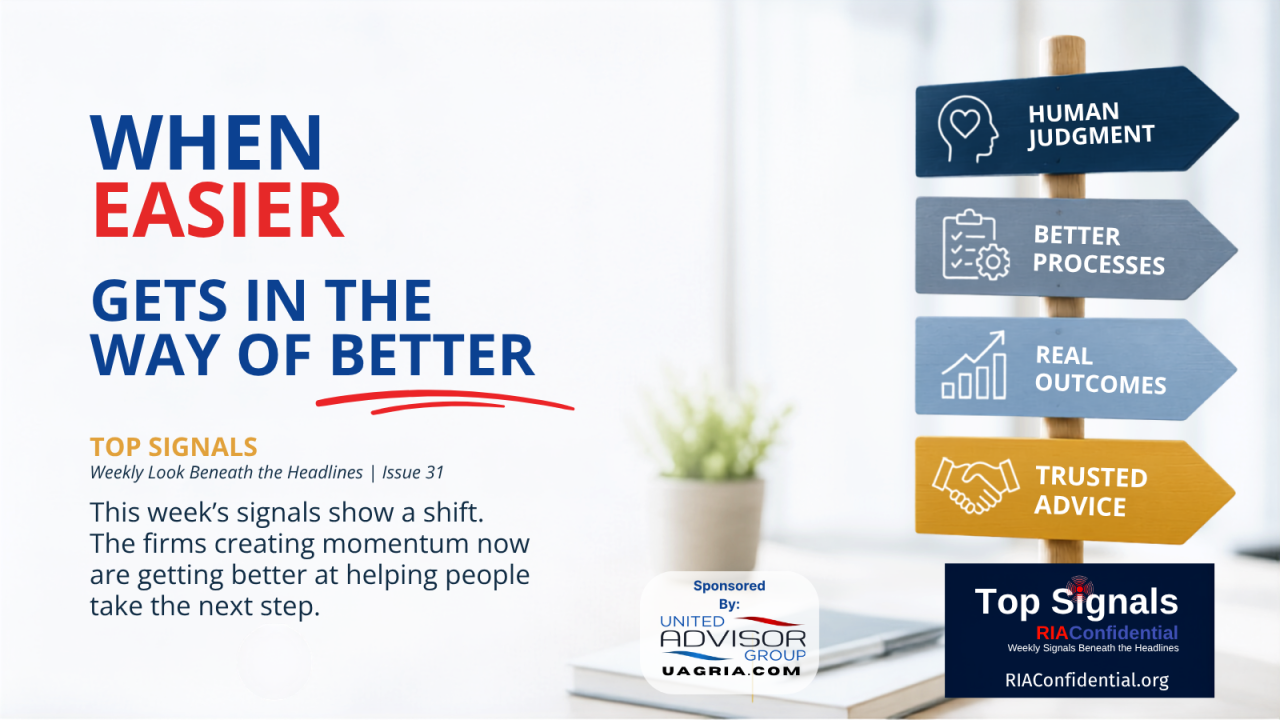
Better isn’t always about doing more. Sometimes, it’s about knowing what deserves your attention—and what doesn’t.
Why convenience, automation, and scale can create new tradeoffs for advisors and the firms they are building
Signal 1: Emotional Intelligence Is Still the Advisor’s Advantage
The Signal
A recent Diamond Podcast conversation with emotional intelligence expert James Woodfall examined why authentic human connection may remain one of an advisor’s clearest advantages in an AI-driven world.
As technology makes information easier to access and increasingly automates routine work, the value of human interaction becomes more—not less—important.
The goal isn’t simply to make the work easier. It’s to make the work better.
Why This Matters
Technology can summarize a meeting.
It can organize data.
It can draft a follow-up.
It can help prepare for a client conversation.
But it cannot read the room the way an experienced advisor can.
It may not recognize when a client says yes while still feeling uncertain. It may not identify when a family is avoiding the real issue. And it cannot reliably determine when the question being asked is not the question that actually needs to be answered.
That is where great advisors continue to create trust.
The opportunity is not to compete with technology on the things technology does better. It is to use technology to create more capacity for the work that depends on judgment, empathy, curiosity, and human connection.
Who This Affects Most
Every advisory firm adopting AI or expanding its use of automation will face this question, particularly firms that compete through high-touch client relationships.
What to Watch Next
Greater emphasis on emotional intelligence and communication skills
AI tools designed to support, rather than replace, client conversations
More advisor training around behavioral and relationship skills
Firms differentiating themselves through human judgment and client experience
Signal 2: Client Action Requires Judgment, Not Pressure
The Signal
Kitces and Carl explored a difficult question: Is it ever appropriate to use fear of adverse outcomes to encourage clients to take action?
The question matters because advisors regularly encounter clients who delay important decisions even when the consequences of waiting are clear.
Why This Matters
Estate documents go unsigned.
Insurance conversations get postponed.
Business owners avoid succession planning.
Families talk around difficult topics instead of through them.
The temptation is to make the risk feel more urgent.
Sometimes clients do need to understand what could happen if they fail to act. But there is a meaningful difference between helping a client see reality and pushing that client through fear.
The better work is often slower.
Ask better questions.
Clarify what the client has already said they want.
Explain the possible consequences in plain language.
Then help the client choose the better next step from a position of understanding rather than panic.
That kind of conversation depends heavily on judgment and trust. It is also difficult to automate well.
Who This Affects Most
Advisors working with complex planning decisions, especially estate planning, insurance, business succession, and other areas where clients routinely delay action.
What to Watch Next
More attention to behavioral approaches to client communication
Greater scrutiny of fear-based sales techniques
Increased emphasis on helping clients connect decisions to their own values
Communication frameworks designed to create urgency without creating unnecessary anxiety
Signal 3: “Simple” Estate Plans Can Hide Real Tradeoffs
The Signal
Another signal this week focused on what can happen when clients ask for a simple estate plan.
Simple sounds good.
Clients want simple. Advisors often want simple. Families usually hope simple will reduce cost, conflict, and confusion.
But in estate planning, simple can sometimes mean incomplete.
Why This Matters
A plan may be easy to understand today while leaving harder decisions for the family later.
It may avoid one layer of complexity while creating another around taxes, control, blended families, beneficiary behavior, or future incapacity.
The advisor’s role is not to make everything complicated.
It is to make the tradeoffs visible.
Sometimes the simplest plan is exactly what a client needs—and sometimes a better plan requires addressing more of the underlying tradeoffs.
Sometimes it is only simple because the harder questions have not been asked yet—and asking those questions can lead to a better outcome.
That distinction matters because clients often judge complexity by how easy something is to explain. Advisors have to evaluate complexity by whether the plan actually addresses the client’s circumstances.
Who This Affects Most
Advisors working with affluent families, business owners, blended families, multigenerational wealth, or clients whose estate plans involve significant tax, control, or succession considerations.
What to Watch Next
Greater client demand for simplified estate-planning experiences
Continued tension between simplicity and completeness
More coordination between advisors, estate attorneys, and tax professionals
Increased focus on identifying unresolved planning decisions before they become family problems
Signal 4: AI Should Start With the Problem, Not the Tool
The Signal
A Zephyr conversation with Elevation Point’s Jim Dickson focused on one of the most important questions firms should ask before implementing AI:
What problem are we actually trying to solve?
That sounds obvious.
It is also where many firms can get off track.
Why This Matters
The technology-first approach starts with the tool.
What can this AI do?
What does the demo look like?
How quickly can we roll it out?
The better starting point is more practical.
What problem are we trying to solve?
Where is the workflow breaking down?
What data is needed?
Who reviews the output?
How will we know if this actually improved anything?
AI can be useful, but only when the firm knows what outcome it wants and can determine whether the technology is actually producing a better result.
Otherwise, AI can become another shiny layer on top of an unclear process.
Convenience is not the same as progress.
A faster process is not necessarily a better process if it produces more errors, creates more review work, or fails to improve the client experience.
Who This Affects Most
Independent RIAs and growing advisory firms evaluating AI for client service, operations, marketing, compliance, research, or internal workflows.
What to Watch Next
AI initiatives tied more closely to measurable business outcomes
Greater attention to data quality and workflow design
Firms redesigning processes before automating them
Increased emphasis on measuring whether AI actually improves operational performance
Signal 5: Some Firms Are Scaling Without Giving Up Control
The Signal
Kitces profiled Shane Morrow of IronBridge Wealth Counsel, a firm that grew from a solo practice into a $3.3 billion enterprise ensemble without taking outside capital.
The story challenges a common assumption about growth: that meaningful scale requires giving something up.
Why This Matters
Many advisors assume scale inevitably comes with tradeoffs involving:
Equity
Autonomy
Culture
Decision-making control
Outside capital may absolutely be the right choice for some firms.
But the IronBridge example demonstrates another path.
Scale can also come from patient structure, role clarity, shared clients, centralized processes, deliberate reinvestment, and an ownership model designed to support the broader enterprise.
That path may require more discipline.
It may be less flashy.
It may take longer.
But for some advisors, it may ultimately create a better business—the business they actually wanted to build.
The easiest path to growth is not necessarily the best fit for the advisor, the team, or the clients.
Who This Affects Most
Advisors considering succession, mergers, partnerships, enterprise growth, or outside capital—and particularly founders trying to determine what kind of firm they want to build over the long term.
What to Watch Next
More advisory firms experimenting with internal ownership models
Continued growth of enterprise-style RIA structures
Greater focus on shared infrastructure and centralized operations
More discussion around the relationship between scale, equity, and control
Signal 6: AI Convenience Is Being Confused With Better Outcomes
The Signal
Another signal this week warned that many firms may be solving for convenience with AI rather than solving for operational outcomes.
That distinction could become one of the most important questions in technology adoption.
Why This Matters
It is easy to mistake motion for improvement.
A tool drafts an email faster.
A meeting summary appears automatically.
A task gets generated.
Everyone feels like the firm is becoming more efficient.
But did the client experience improve?
Did onboarding get cleaner?
Did fewer items come back incomplete?
Did advisors gain more time for meaningful client conversations?
Did compliance review become stronger?
Those are the questions that count.
Technology should not be evaluated simply because it makes work feel more modern or because it reduces the number of minutes spent on a task.
The real test is whether the work itself improves and creates a better outcome for the firm, its advisors, and its clients.
Who This Affects Most
Any firm investing heavily in AI, particularly firms implementing multiple tools across client service, operations, marketing, compliance, and advisor workflows.
What to Watch Next
More firms measuring AI against operational KPIs
Greater scrutiny of automation that creates additional review work
Increased focus on client experience as a technology metric
AI adoption shifting from experimentation toward measurable business outcomes
Signal 7: Some Tools Fit a Specific Client—and Fail Many Others
The Signal
A WealthManagement piece examined when a Delaware Statutory Trust actually fits an RIA client.
The conclusion is a useful reminder: access is not advice.
DSTs can be appropriate in certain situations. They can also be wrong for plenty of clients.
That principle extends well beyond DSTs.
Why This Matters
Advisors today have access to more products, strategies, platforms, and investment structures than ever before.
But availability does not create suitability.
The advisor’s job is not to use every available tool.
It is to determine when a tool fits the client’s facts, goals, time horizon, liquidity needs, risk tolerance, tax situation, and broader financial plan.
That requires filters.
It requires due diligence.
And it requires the ability to say no—even when a product is available and the client is interested in it.
Open architecture is only powerful when judgment sits in front of it—and when advisors use that judgment to determine which option is better for the client.
Who This Affects Most
Advisors serving high-net-worth and complex clients, particularly firms with broad product access or relationships with alternative investment providers.
What to Watch Next
Greater scrutiny of product fit and client-specific suitability
Continued expansion of alternative investment access
More advisor due diligence around complex products
Increased emphasis on disciplined product-selection frameworks
The Bigger Pattern
The common thread this week is simple:
Easier is not always better.
AI may make some tasks easier, but that does not automatically make the firm stronger.
A simple estate plan may feel easier, but it can leave important questions unresolved.
A product may be accessible, but that does not make it appropriate.
Growth may become easier with outside capital, but the tradeoffs still need to be understood.
Client action may come faster with fear, but trust is built through clarity, empathy, and good judgment.
The deeper challenge is that advisors and firms are surrounded by more options than ever.
More technology.
More products.
More platforms.
More paths to growth.
The advantage may belong to the advisors who can slow down long enough to ask one question:
Is this actually better?
What This Means for Advisors
If you are evaluating independence, a platform, technology, a product strategy, or the next stage of your firm’s growth, the question is no longer simply what gives you more.
It is what helps you make better decisions.
Ask:
Can your platform help you measure real operational improvement, or does it simply offer more tools?
Can your technology create more time for client conversations, or does it add more workflow clutter?
Can your product shelf support disciplined advice, or does it tempt the firm into complexity without enough filters?
Can your growth path preserve the kind of firm you actually want to build?
Can your process help clients move forward without using fear as the primary motivator?
Can you tell the difference between something that is easier and something that is genuinely better?
Those are the questions that separate activity from progress.
Editorial Note
RIA Confidential publishes Signals for informational purposes, highlighting structural patterns beneath weekly headlines. This issue is educational and is not legal, tax, compliance, or investment advice.
About RIA Confidential
RIA Confidential covers the business, regulation, and infrastructure of the RIA ecosystem, tracking capital flows, platform strategy, advisor mobility, and the operational realities of independence.
Disclosure
This publication is for informational and educational purposes only and does not constitute legal, tax, compliance, or investment advice. Readers should consult qualified professionals for advice specific to their circumstances. The investment strategy and themes discussed herein may be unsuitable for investors depending on their specific investment objectives and financial situation. Information obtained from third-party sources is believed to be reliable though its accuracy is not guaranteed. Opinions expressed in this commentary reflect subjective judgments of the author based on conditions at the time of publication and are subject to change without notice. Past performance is not indicative of future results.