There are some enormous numbers floating around the RIA business right now.
Fidelity reported roughly $343 billion in client assets involved in RIA transactions during the first half of 2026. AE Wealth is building toward $250 billion in managed assets. Baker Street Advisors has grown to roughly $21 billion. Everywhere you look, firms are combining, platforms are expanding, technology is getting more sophisticated, and everybody seems to be talking about scale.
But as I worked through all of that this week, I found myself wondering about something a little more basic:
Is any of this actually making it easier to be an advisor?
Because I would think that is one of the reasons we want scale in the first place.
Better technology should take some work off the advisor’s plate. More people should give us access to expertise we didn’t have before. A larger organization should be able to solve certain problems faster than we could solve them alone.
And somewhere in all of that, the client should feel a difference too.
Maybe they get answers faster. Maybe their advisor has more time for them. Maybe they gain access to planning expertise or services they didn’t have before.
Whatever it is, scale should make the relationship better on both sides.
Anyone who has spent enough time around large organizations also knows the other side of the equation. Bigger can bring more systems, more handoffs, more approvals, more people to call, and more time trying to figure out who actually owns the problem you’re trying to solve.
So perhaps the better question isn’t simply how much scale is being created.
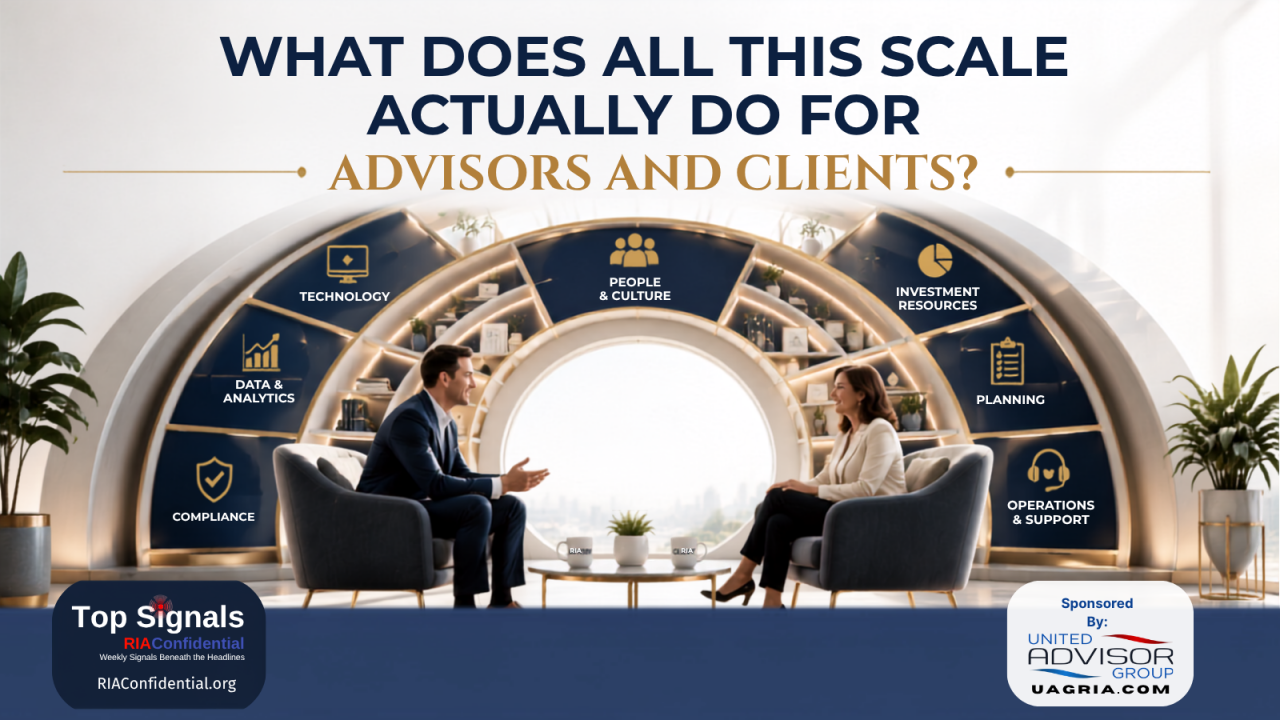
It’s what that scale actually does for advisors and their clients.
Signal 1: The Numbers Really Are Getting Bigger
The Signal
Fidelity’s midyear RIA M&A data offers a pretty striking illustration of where the market is heading.
The number of RIA transactions fell 9% in the first half of 2026, from 132 to 120. Yet the client assets involved in those transactions jumped 88%, reaching approximately $342.9 billion. The median acquired RIA also grew from $517 million to $630 million.
Fewer transactions.
Much larger transactions.
That tells us something important about the direction of consolidation.
The RIA market isn’t simply becoming more active. It is becoming more concentrated around larger, more established firms and platforms.
Why This Matters
I don’t think consolidation is inherently good or bad.
There are plenty of good reasons firms merge, sell, acquire, take outside capital, or join larger organizations. A combination can give advisors and clients access to resources that would have been difficult or expensive to build independently.
But the size of the transaction can distract us from what happens after the announcement.
What actually gets better?
That is where meaningful scale should show up: in better resources, stronger support, and a better client experience.
If combining two organizations creates better resources, stronger technology, more expertise, greater capacity, and a better client experience, there is real value in that.
That benefit should also be considered alongside the conflicts and client-interest obligations that apply to investment advisers.
If the biggest change is simply the number on the press release, I’m not sure the advisor or client feels much different on Monday morning.
And I think Monday morning matters.
Who This Affects Most
Owners considering a sale or minority investment, advisors evaluating larger platforms, and firms pursuing acquisitions all need to think beyond transaction size.
The question is not just what the deal creates on paper.
It is what changes in the day-to-day experience of running the business and serving clients.
What to Watch Next
Continued growth in the size of RIA transactions
More institutional capital flowing toward larger firms
Buyers placing greater emphasis on client experience and strategic fit
Whether consolidation produces measurable improvements in advisor capacity and service
Signal 2: Growth Has a Way of Bringing Complexity With It
The Signal
Growth usually starts with a good reason.
You add a system because you need it. You add another service because clients are asking for it. You hire another person because the team is stretched. You create a new process because the old one no longer works.
Then something interesting happens.
The firm has more capability than it used to have, but it also has more moving parts.
One system doesn’t quite talk to another. Someone develops a workaround. A new client requires an exception. Another employee builds a spreadsheet to bridge a gap. A process that once took five minutes now involves three people.
None of those decisions necessarily looks unreasonable on its own.
Collectively, they can create a very complicated business.
Why This Matters
This is where I think scale deserves a simple test:
Good scale should make something that used to be difficult easier to do well.
If the organization is getting bigger while everything inside it is becoming harder, I would want to understand why.
More capacity is valuable.
More complexity is not automatically valuable.
The goal should be to increase what the firm can accomplish without increasing friction at the same rate. Effective scale should increase capacity without making the business harder to operate.
Who This Affects Most
Growing RIAs, multi-office firms, and platforms adding technology or services are particularly vulnerable to this kind of complexity.
The more systems and people involved in a process, the more important it becomes to understand who owns the outcome.
What to Watch Next
Firms simplifying technology stacks after periods of rapid growth
Greater attention to workflow integration
More investment in operational design
Advisors measuring time saved rather than simply counting tools added
Signal 3: Baker Street Offers a Different Example of Scale
The Signal
Baker Street Advisors was probably my favorite signal this week.
The firm has grown to roughly $21 billion in assets under management, largely through organic growth, client commitment, referrals, and developing advisors internally rather than building itself through a long string of acquisitions. Its organic growth has averaged roughly 12% over the past 15 years.
That is serious scale.
But what interests me is what appears to have been scaled along the way:
Relationships.
People.
Reputation.
Client service.
There is something useful about that distinction.
Scale does not always have to mean adding another firm.
Sometimes it means getting very good at what you already do and building an organization capable of doing more of it without losing what made it work in the first place.
Why This Matters
If referrals are an important part of growth, clients are effectively telling you something.
People generally don’t introduce someone they care about to an advisor unless they feel pretty good about the experience they’re having.
That makes client service more than a retention strategy.
It can become part of the growth engine.
And that may be one of the more durable forms of scale available to an advisory firm.
Who This Affects Most
Independent RIAs and founder-led firms may find this especially relevant.
You don’t necessarily need to become an aggressive acquirer to build a large business. You may be able to scale by strengthening the underlying organization, developing people, and creating an experience clients want to recommend.
What to Watch Next
Organic growth rates among large RIAs
Advisor development and succession programs
Referral-driven growth
Firms preserving culture while expanding significantly
The relationship between client experience and long-term growth
Signal 4: The Advisor Experience May Be the Real Platform
The Signal
AE Wealth caught my attention for another reason.
The company is targeting $250 billion in managed assets by 2035 while emphasizing technology, expanded services, and what leadership describes as an “advisor experience layer.” The firm recently reported just over $52 billion across roughly 600 advisors and is rebuilding its advisor portal as part of that strategy.
I actually like that phrase because it puts the conversation somewhere I think it belongs.
If you’re going to build a $50 billion, $100 billion, or $250 billion organization around advisors, their experience using that organization ought to matter.
Why This Matters
Can an advisor onboard a client faster?
Can they get an answer when something goes wrong?
Does information move between systems without someone having to enter the same thing three times?
If there is a complicated client situation, can the advisor quickly reach someone who knows how to help?
And at the end of the week, did the platform give the advisor more time to actually advise?
To me, that’s scale the advisor can feel.
And if the advisor has more time, better resources, and easier access to expertise, hopefully the client feels it too. That matters because an investment adviser’s fiduciary duty extends across the advisory relationship and centers on the client’s best interest.
Maybe the meeting is better.
Maybe the answer comes faster.
Maybe a complicated planning issue doesn’t require three weeks of back-and-forth.
That’s when scale starts benefiting both sides of the table.
Who This Affects Most
Advisors evaluating large platforms should pay close attention to the actual experience of using the platform—not simply the size, technology budget, or number of services being offered.
What to Watch Next
Advisor portals becoming central operating environments
Greater integration between technology and human support
Platform investments designed around advisor workflows
Measurement of advisor time saved and client outcomes improved
Signal 5: Technology May Make Personalization More Scalable
The Signal
Edelman Financial Engines offers another interesting example of what useful scale could look like.
The firm is connecting workplace retirement relationships with broader wealth planning while using technology and AI to support planners. Its workplace offering already combines personalized retirement guidance, digital tools, and access to licensed advisors.
This is where technology and AI become especially interesting to me.
There are enormous numbers of people participating in workplace retirement plans, and serving all of those people in a truly personal way has always been difficult.
Personalization takes time.
Technology may begin changing that equation.
AI can help organize information, identify opportunities, triage needs, and help advisors communicate with more people without requiring every interaction to start from zero.
Why This Matters
Something that has historically been difficult to do at scale may be getting easier to do well. That is one of the clearest ways technology can turn scale into a better experience for both advisors and clients.
And in this case, the potential benefit isn’t hard to see.
The advisor can potentially serve more people efficiently, while someone who may never have had access to personalized guidance gets a better financial experience.
That’s useful scale.
It expands access without necessarily requiring every additional client to create a proportional increase in advisor workload.
Who This Affects Most
Firms serving large client populations, workplace retirement participants, emerging wealth segments, and other markets where traditional high-touch advice has been difficult to deliver economically.
What to Watch Next
AI-assisted financial planning workflows
Workplace-to-wealth strategies
Greater personalization at scale
Human oversight remaining central to AI-enabled advice
Technology that expands advisor capacity rather than simply adding automation
Signal 6: The People We Need to Serve Are Changing Too
The Signal
Another story this week looked at small businesses and gig workers and how they are reshaping workplace savings.
It’s easy to skim past a story like this.
I think it deserves more attention.
The traditional picture of someone working for the same large employer for decades doesn’t describe nearly as many people as it once did.
People own small businesses.
They consult.
They freelance.
They work for themselves.
They move between employment and entrepreneurship.
Sometimes they do several of those things at the same time.
Their financial lives don’t always fit neatly into traditional advice models either.
Why This Matters
That creates an opportunity for advisors willing to think differently about whom they serve and how they reach them.
This is another place where scale and technology can become useful.
They may allow firms to serve markets that would have been difficult to serve economically in the past.
That’s a pretty meaningful use of scale.
It allows you to help more people without watering down the quality of the help.
Who This Affects Most
Advisors looking for new client segments, firms building scalable planning models, and platforms exploring ways to reach people outside traditional wealth-management channels.
What to Watch Next
New advice models for entrepreneurs and independent workers
More flexible workplace and retirement solutions
Technology-enabled financial planning for underserved segments
Business models that combine efficiency with personalization
Signal 7: Technology Should Earn Its Place
The Signal
We also saw another collection of new advisor tools this week, including technology aimed at organic growth, valuation, communication, and AI-enabled work.
There will be plenty more.
And I’m excited about a lot of what’s coming.
But I keep coming back to a question we talked about last week:
What problem are we trying to solve?
I think that question becomes even more important as firms and platforms grow.
Every new tool brings another workflow, another source of data, another thing people have to learn, and potentially another place where something can go wrong.
Why This Matters
Before adding something, I would want to know what becomes easier because it exists.
Does it save the advisor time and improve the client experience?
Maybe every tool won’t do both. But the best ones probably ought to move us in that direction.
Does it eliminate a manual step?
Help someone make a better decision?
Allow the firm to serve more people without simply asking everybody to work longer hours?
If it does, great.
That technology has earned its place.
If we’re struggling to explain what actually got easier, maybe we need to ask ourselves why we added it.
Who This Affects Most
Every advisory firm adding technology, particularly firms already dealing with multiple systems, overlapping workflows, or technology fatigue.
What to Watch Next
Consolidation among advisor technology providers
AI tools embedded directly into existing workflows
More scrutiny of technology ROI
Firms measuring adoption and time savings
Technology decisions increasingly tied to client experience
The Bigger Pattern
As I finished reading this week’s signals, I realized that most of them were really asking some version of the same question:
What is scale for?
I don’t think the answer is simply more AUM, more offices, more advisors, more technology, more services, or more acquisitions.
Those can all be signs of growth.
They can create tremendous opportunity.
But eventually, all that “more” should make something better.
To me, the best kind of scale creates a benefit on both sides of the relationship.
The advisor gets better resources, better support, less friction, or more time.
The client gets better service, greater capabilities, faster answers, or simply more of their advisor’s attention.
That’s when getting bigger starts making things better.
Otherwise, I’m not sure what we accomplished besides getting larger.
What This Means for Advisors
If you’re considering a new platform, joining a larger organization, adding technology, expanding your team, or simply trying to build more scale inside your own RIA, I think there is a useful question to keep somewhere in the conversation:
What becomes easier because of this?
Maybe it becomes easier to serve the client or run the business.
Maybe you gain access to expertise you could never justify building internally.
Maybe the team can handle substantially more business without complexity growing at the same rate.
Or maybe—and I think this one matters a lot—it gives you another five hours a week to spend doing the part of the job you actually became an advisor to do.
If those extra hours result in better conversations, faster follow-up, more thoughtful planning, or simply more attention for the client, then everybody benefits.
Those are benefits I can understand.
And I’d want to understand them before getting too excited about the size of anything.
Editorial Note
RIA Confidential publishes Signals for informational purposes, highlighting structural patterns beneath weekly headlines. This issue is educational and is not legal, tax, compliance, or investment advice.
About RIA Confidential
RIA Confidential covers the business, regulation, and infrastructure of the RIA ecosystem, tracking capital flows, platform strategy, advisor mobility, and the operational realities of independence.
Disclosure
This publication is for informational and educational purposes only and does not constitute legal, tax, compliance, or investment advice. Readers should consult qualified professionals for advice specific to their circumstances. The investment strategy and themes discussed herein may be unsuitable for investors depending on their specific investment objectives and financial situation. Information obtained from third-party sources is believed to be reliable though its accuracy is not guaranteed. Opinions expressed in this commentary reflect subjective judgments of the author based on conditions at the time of publication and are subject to change without notice. Past performance is not indicative of future results.