Artificial intelligence dominated the headlines again this week.
One firm expanded advisor access to Claude. Another built its own AI operating system. Industry conferences continued to debate how AI will reshape wealth management.
But after looking across this week’s stories, technology didn’t emerge as the biggest theme.
Leverage did.
Across the advisory industry, firms are asking the same fundamental question:
How do we serve more clients, improve the client experience, and continue growing without adding complexity at the same pace?
That question surfaced in conversations about AI, model portfolios, advisor development, ownership structures, leadership, and operational design.
The firms making meaningful progress aren’t simply adopting new technology. They’re becoming far more intentional about where advisors should spend their time, where systems can create scale, and what parts of the client relationship should remain distinctly human.
Here are this week’s most important signals.
Signal 1: AI Is Moving Into the Advisor’s Daily Workflow
NewEdge Advisors is giving advisors direct access to Anthropic’s Claude for portfolio analysis, meeting preparation, prospect research, and client communication—with compliance guardrails and data protections built into the platform.
This reflects an important shift in how firms are approaching AI.
Rather than experimenting quietly or restricting usage altogether, firms are beginning to integrate AI directly into everyday advisor workflows while establishing governance around its use.
Why It Matters
AI is becoming less of a future initiative and more of a productivity tool.
When implemented responsibly, it can reduce the time advisors spend preparing for meetings, researching opportunities, reviewing information, and drafting communications.
That creates additional capacity for the activities clients value most—planning, relationship management, and judgment.
The competitive advantage won’t simply come from adopting AI.
It will come from integrating AI into advisor workflows without compromising compliance, security, or trust.
Signal 2: Workflow Is Becoming a Competitive Asset
One Texas RIA partnered with Altruist to build its own AI-powered operating system while transitioning approximately $450 million in client assets to the platform. The firm ultimately plans to make its software available to other advisors.
While few firms will build proprietary operating systems, the broader lesson extends well beyond technology.
Why It Matters
Independence isn’t only about ownership.
It’s increasingly about operational control.
Firms that own their workflows, technology strategy, and data architecture gain greater flexibility to build around the needs of their advisors and clients instead of adapting to someone else’s platform.
The more intentionally firms design their operating systems, the greater leverage they create across the business.
Signal 3: Model Portfolios Continue to Shift Advisor Value
Broadridge projects model portfolio assets could reach $18.6 trillion by 2030, underscoring how rapidly implementation continues to evolve.
The projection itself is significant.
The strategic implications are even more important.
Why It Matters
As model portfolios become the default investment engine for many firms, implementation becomes increasingly standardized.
That’s not necessarily a disadvantage.
Models reduce operational burden, improve consistency, and create additional advisor capacity.
But they also change where firms differentiate themselves.
As portfolio implementation becomes more efficient, advisor value increasingly shifts toward planning, behavioral coaching, tax strategy, retirement income, and helping clients navigate complex decisions.
Technology may execute more of the portfolio.
The advisor continues to own the relationship.
Signal 4: Growth Eventually Becomes a Leadership Challenge
SEIA’s Matt Matrisian recently discussed the enterprise mindset required for advisory firms moving beyond founder-led growth.
Every successful RIA eventually reaches the point where informal management no longer works.
Infrastructure becomes more important.
Leadership becomes more intentional.
Processes become more consistent.
Why It Matters
Many firms successfully grow through founder energy, entrepreneurial flexibility, and strong personal relationships.
Eventually those strengths become limitations.
Scaling requires clearer leadership structures, stronger operational systems, and infrastructure capable of supporting a much larger organization.
How firms navigate that transition often determines whether growth creates lasting enterprise value—or operational strain.
Signal 5: Business Development Must Become Transferable
Kitces highlighted an issue many advisory firms continue to face: developing the next generation of business builders.
Many firms still rely heavily on one founder or senior advisor to generate new business.
That model eventually reaches its limits.
Why It Matters
Sustainable growth requires business development to become teachable.
That means helping emerging advisors clearly articulate the firm’s value proposition, identify ideal clients, and confidently lead prospect conversations.
The firms investing in advisor development today are building organizations that can continue growing long after the founders step back.
Technology may improve productivity.
People still determine long-term growth.
Signal 6: Ownership Structure Shapes More Than Capital
Creative Planning recently reaffirmed that it has no plans to become a public company, instead emphasizing employee ownership and long-term flexibility.
While ownership discussions often focus on finance, they ultimately influence much more.
Why It Matters
Ownership determines incentives.
It affects decision-making, recruiting, pricing, investment horizons, culture, and ultimately the client experience.
Whether a firm is employee-owned, private equity-backed, publicly traded, or independently owned, the capital behind the business influences how leadership defines success.
Advisors evaluating partnerships, acquisitions, or independence should understand those incentives as carefully as they evaluate compensation.
Signal 7: Centralization Is Becoming Part of the Client Experience
Hightower’s 3.0 strategy emphasizes centralizing middle-office functions, onboarding, investment management, and operational support.
While these changes often happen behind the scenes, clients increasingly experience the benefits directly.
Why It Matters
Operational excellence has become client experience.
Clients notice smooth onboarding.
They notice reliable money movement.
They notice consistent reporting.
They notice when operational problems disappear.
Centralization creates leverage only when execution improves the advisor experience as much as the operational process.
Done well, advisors gain more time while clients receive a more consistent experience.
The Bigger Pattern
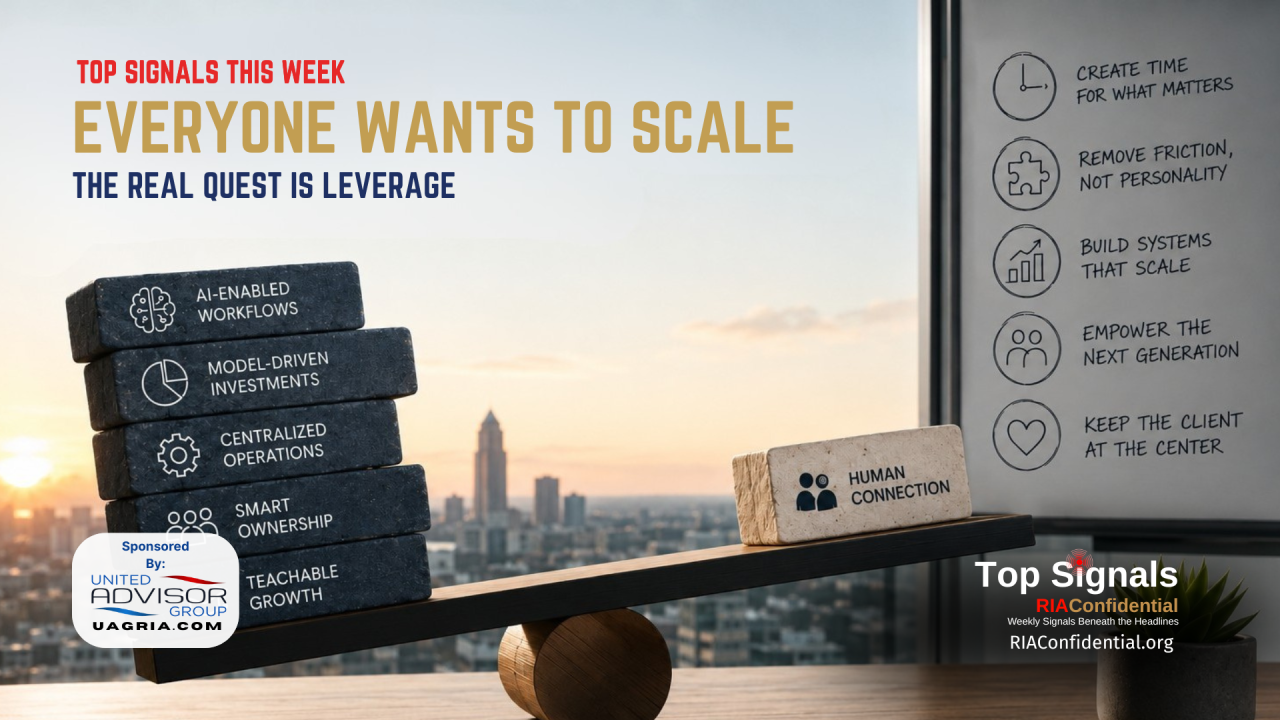
Viewed together, this week’s signals reveal an industry becoming increasingly intentional about leverage.
Leverage isn’t simply about automation.
It’s about creating more room inside the business.
Room for advisors to spend more meaningful time with clients.
Room for emerging advisors to grow into leadership.
Room for better planning, stronger communication, and more thoughtful advice.
AI, model portfolios, centralized operations, and stronger advisor development all contribute to that goal—but only when they’re aligned around a clear operating strategy.
Technology creates leverage only when firms know what they’re trying to make easier.
What This Means for Advisors
Whether you’re evaluating independence, considering a platform change, or planning your firm’s next stage of growth, now is a good time to evaluate where leverage exists—and where it doesn’t.
Ask yourself:
Is growth still dependent on one or two key people?
Are advisors spending too much time on work technology or centralized support could handle?
Is the investment process creating capacity—or consuming it?
Can emerging advisors confidently communicate the firm’s value?
Does the ownership model align with the firm’s long-term goals?
Is the platform simplifying the client experience or introducing additional complexity?
The answers to those questions reveal much more than operational efficiency.
They reveal how prepared the firm is for sustainable growth.
Bottom Line
This week’s signals point toward a clear evolution in how successful RIAs are building their businesses.
Artificial intelligence is moving into advisor workflows.
Model portfolios are handling more implementation.
Operational platforms continue to centralize support.
Leadership, ownership, and advisor development are becoming increasingly strategic.
The firms that pull ahead won’t simply adopt more technology.
They’ll understand what to automate, what to centralize, what to teach, and what should remain unmistakably human.
Growth is easy to measure.
Leverage is harder to see.
But leverage ultimately determines whether growth strengthens the business—or simply creates more work.
Editorial Note
RIA Confidential publishes Signals for informational purposes, highlighting structural patterns beneath weekly headlines. This issue is educational and is not legal, tax, compliance, or investment advice.
About RIA Confidential
RIA Confidential covers the business, regulation, and infrastructure of the RIA ecosystem, tracking capital flows, platform strategy, advisor mobility, and the operational realities of independence.
Disclosure
This publication is for informational and educational purposes only and does not constitute legal, tax, compliance, or investment advice. Readers should consult qualified professionals for advice specific to their circumstances. The investment strategy and themes discussed herein may be unsuitable for investors depending on their specific investment objectives and financial situation. Information obtained from third-party sources is believed to be reliable though its accuracy is not guaranteed. Opinions expressed in this commentary reflect subjective judgments of the author based on conditions at the time of publication and are subject to change without notice. Past performance is not indicative of future results.