Most advisors who have been running a firm for a while probably already know where some of the friction is.
You know which process takes too long and still depends on you a little too much. You know which part of the client experience could be better, which piece of technology doesn’t really live up to the promise, and which problem keeps getting pushed into next quarter because something more urgent always seems to come up.
And if growth has slowed, there’s a good chance you already have a pretty good idea why.
That’s one of the funny things about owning a business. We spend a lot of time looking for answers, when sometimes the answer has been sitting right in front of us for a while.
This week’s signals kept bringing me back to the same idea:
Seeing the problem is one thing. Doing something about it is another.
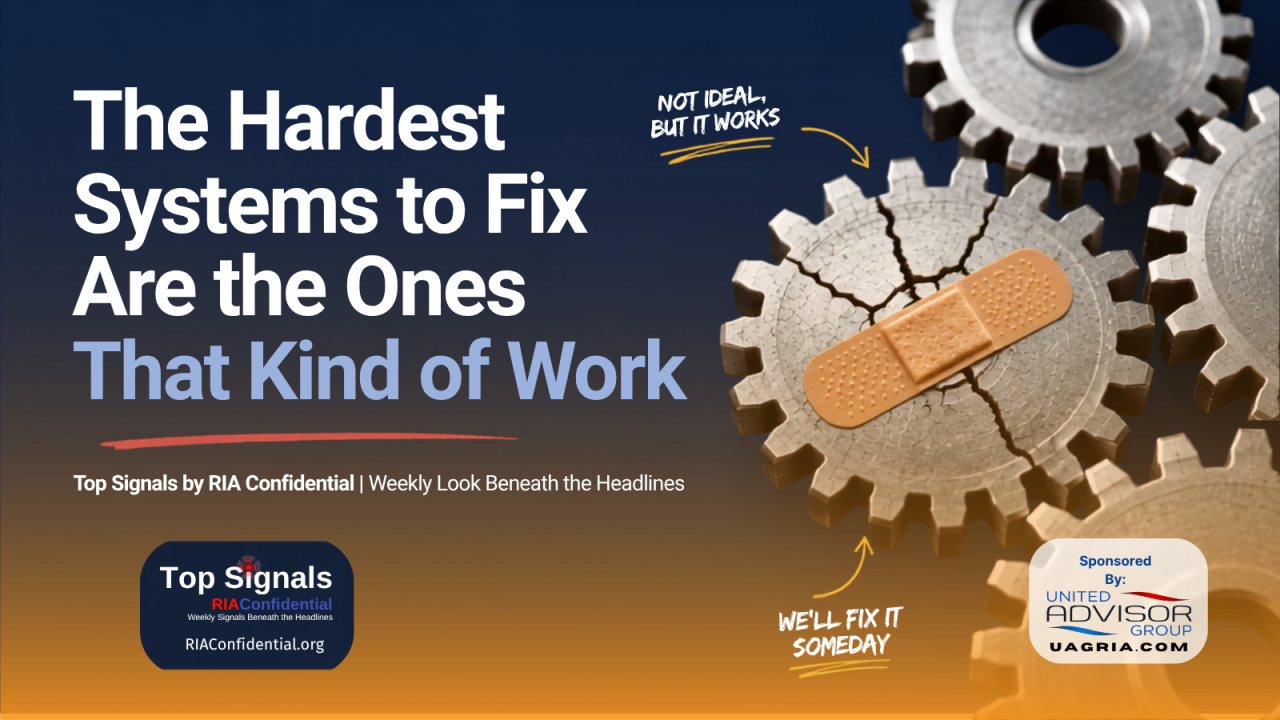
The hardest things to fix are often not the things that are completely broken.
They’re the things that still work.
Signal 1: If You’re Measuring It, Be Willing to Act on It
One of this week’s articles had a title that stuck with me: “Stop Measuring What You Won’t Change.”
I think a lot of firms could use that as a pretty good test.
We can measure almost anything now.
Leads. Conversion rates. Revenue per household. Client retention. Meeting frequency. Staff capacity. Marketing activity. Profitability. Time spent on different kinds of work.
But the number itself doesn’t help much unless it leads to a decision.
If meetings are taking too much advisor time, maybe the meeting process needs to change.
If leads are coming in but not converting, maybe the issue isn’t marketing at all.
If your best people are spending hours every week on work someone else could handle, that’s probably telling you something too.
Those patterns often point to systems that are creating more friction than value.
For advisory firms, that same discipline matters in compliance. The SEC expects registered investment advisers to maintain written policies and procedures designed to address the risks specific to their operations and to review those policies and procedures regularly.
Those patterns usually point to systems that are creating more friction than value.
I don’t think most firms need more dashboards.
They probably need a smaller number of things they care enough about to change when the answer isn’t what they hoped it would be.
The right systems should make those decisions easier to see and easier to act on.
The takeaway
Measurement only creates value when it changes behavior.
The goal shouldn’t be to know everything about the business.
It should be to know enough about the right things to make better decisions.
Signal 2: Advisors Are Asking Better Questions About Alternatives
Another signal showed that demand for alternatives remains strong, but advisor priorities are changing.
Risk and performance analytics are becoming more important, while some of the basic access and paperwork functions are moving further down the list.
That makes sense to me.
When something is new, the first question is usually:
“Can we get access to it?”
Once access becomes easier, the questions start getting better.
How does this fit the client?
What are we really taking on here?
How do we monitor it?
What could go wrong?
And if a client asks why they own it, can we explain the answer in plain English?
I think that’s a healthy progression.
It’s also a pretty good example of what happens inside a growing firm.
Eventually, the question shifts from whether you can offer something to whether you’re actually doing it well.
The same is true of the systems behind the work: having the capability is one thing, but having a repeatable system for delivering it well is another.
The same shift applies to the systems behind the work: having the capability is one thing, but building a repeatable way to deliver it well is another.
The takeaway
Capability is not the same thing as quality.
As access to products, technology, and new capabilities becomes easier, the real differentiator becomes how thoughtfully the firm uses them.
Signal 3: Sometimes Growth Starts by Understanding Clients Better
Wescott Financial stood out to me this week because its approach is grounded in planning, psychology, and a deeper understanding of client goals.
There’s something pretty basic in that idea that can get lost when we start talking about growth.
Advisors spend a lot of time looking for ways to generate more referrals, attract more prospects, improve marketing, or build a better growth engine.
Sometimes the next opportunity is sitting inside the relationships you already have.
Get better at understanding the people you serve.
Ask better questions.
Make the planning process more useful.
Create an experience clients naturally want to talk about when someone asks who they work with.
There’s nothing flashy about that.
But a lot of very good advisory firms have grown exactly that way for a long time.
The takeaway
Growth doesn’t always begin with finding more people. Sometimes it begins with serving the people you already have better.
A stronger client experience can become a growth engine of its own.
Signal 4: Structure Can Create More Capacity Than We Think
Another story featured a three-person team managing approximately $240 million through a structured meeting approach.
The asset number is impressive, but the part that interested me was how they organized the work.
Every growing advisor eventually runs into the same wall.
There are only so many hours in the day.
Hiring may be the right answer, and sometimes it absolutely is.
But before adding another person, it’s worth looking at how the work itself gets done.
How much preparation does every meeting require?
Who owns each part of it?
What happens afterward?
How often is the team recreating something that could have been standardized a year ago?
Clear ownership matters just as much in supervisory processes. Firms need to know who is responsible for particular activities and how those responsibilities are documented and reviewed.
Those aren’t especially exciting questions.
But solving them can create a surprising amount of room.
Sometimes the firm needs another person.
Sometimes it needs a better way of working.
Better systems can create that capacity without automatically adding another layer of complexity.
Better systems can often create that capacity without adding another layer of complexity.
The takeaway
Capacity isn’t always created by adding people. Sometimes it’s created by removing unnecessary work.
Before assuming the answer is another hire, look carefully at how the existing team spends its time.
Signal 5: Client Needs Have a Way of Pulling the Firm Forward
SEIA announced a new tax division and expanded family office capabilities through a partnership with Baker Tilly.
That caught my attention because successful clients rarely experience their financial lives in separate boxes.
Investments affect taxes.
Tax decisions affect estate planning.
Business decisions affect retirement.
A family conversation can easily touch several professionals at once.
The advisor often ends up in the middle, helping the client make sense of how all the pieces fit together.
I don’t think that means every RIA needs to hire a tax team or become a family office.
But I do think firms need to pay attention when client needs begin changing.
Maybe you build the capability.
Maybe you find the right partner.
Maybe you improve the way you coordinate with the client’s existing professionals.
The answer will look different from firm to firm.
The important part is noticing when the people you serve are asking the business to evolve.
The takeaway
Your clients’ changing needs can be an early signal that your firm needs to change too.
You don’t necessarily need to build everything in-house.
But you do need to make sure the client experience keeps up with the complexity of the clients you serve.
Signal 6: Technology Works Better When It Has a Job to Do
Another discussion this week looked at what NextGen advisors expect from AI and technology, especially around productivity and entrepreneurship.
I’m excited about what’s happening there.
At the same time, I think we’re reaching a point where firms need to be a little more selective.
There will always be another AI tool, another platform, another integration, and another demo that makes something look incredibly easy.
Before adding one, I’d ask a very simple question:
What problem are we trying to solve?
If the answer is clear, technology can be incredibly useful.
It can save time, improve consistency, and free people up to do higher-value work.
If nobody can answer the question, another subscription probably isn’t going to fix much.
The takeaway
Technology should solve a business problem, not create a new one.
The best technology decisions usually start with the workflow, not the tool.
The best systems work the same way: start with the business problem, then decide what technology should support it.
The same principle applies to systems: start with the work that needs to get done, then decide what technology should support it.
Signal 7: Repeatability Has Value Even If You Never Plan to Sell
One of the final signals this week looked at the valuation gap in RIA M&A and why systematized growth can command a premium.
Even if selling your firm is nowhere on your radar, I think there’s something useful in that.
Why would a buyer put more value on repeatable growth?
Because they can understand it.
They can see where new clients come from.
They can see how the client experience works.
They can tell whether growth depends on one rainmaker or whether the firm has built something that can keep going.
Those same qualities make a business better to own.
A firm that understands its economics, has a consistent client experience, develops its people, knows where growth comes from, and can spot problems early is simply easier to lead.
You don’t need a buyer to tell you that has value.
The takeaway
A business doesn’t have to be for sale to benefit from being built like someone else might eventually have to run it.
Repeatability creates clarity, capacity, and resilience.
Well-designed systems are what make that repeatability possible.
Well-designed systems are what make that repeatability possible.
The Bigger Pattern
As I finished reading this week’s signals, I kept coming back to how much information advisory firms have available to them now.
We can measure the business in ways we couldn’t twenty years ago.
We can analyze portfolios more deeply, track client behavior, benchmark performance, watch workflows, and use AI to surface patterns we might have missed ourselves.
All of these tools can strengthen the systems behind the business, but only when someone is willing to act on what they reveal.
The same principle applies to compliance: identifying patterns is useful only if the firm uses what it learns to evaluate risks and improve its policies and procedures. The SEC’s guidance encourages advisers to periodically assess the risks present in their businesses and evaluate whether their compliance programs remain effective.
All of that is useful.
But somewhere along the line, somebody still has to look at what the information is saying and make a decision.
And I think that’s where a lot of businesses get stuck.
When something is completely broken, we usually fix it.
The harder changes are the things that still work reasonably well.
The process that gets the job done, but takes twice as long as it should.
The client segment that still generates revenue, but drains the team.
The meeting structure everyone is used to, even though nobody loves it.
The technology that technically works, even though the firm has outgrown it.
These systems can be especially difficult to change because they have become familiar.
Those things are harder because there’s always a reason to leave them alone.
Until one day you realize you’ve been talking about fixing the same thing for three years.
Why This Matters for Independent Advisors
One of the things I’ve always liked about independence is that you have the ability to change the business when you see a better way.
You can redesign the process.
You can change the technology.
You can build a different service model.
You can hire differently.
You can decide that something that worked five years ago no longer fits the firm you’re building today.
That freedom is a real advantage.
But it still leaves you with the decision.
And independence doesn’t automatically make a firm adaptable.
It simply gives the owner more control over whether the firm adapts.
That distinction matters.
A growing advisory firm accumulates systems, habits, processes, technology, meeting structures, service models, and assumptions.
Some of them remain useful.
Some become inefficient.
Some quietly become obstacles.
The challenge is recognizing which is which.
What to Watch Next
The signals point toward a broader shift in how advisory firms think about growth and operational improvement.
Watch for firms that:
Turn business metrics into actual decisions rather than simply reporting them.
Become more selective about technology and alternative investments.
Build growth around deeper client relationships.
Create capacity through better processes and clearer ownership.
Respond to increasingly complex client needs through partnerships and new capabilities.
Treat AI as a tool for specific problems rather than an objective in itself.
Build repeatable systems that reduce dependence on individual people.
The common thread is not any particular technology, product, or growth strategy.
It is intentionality.
The strongest firms are increasingly asking not just, “Does this work?”
They’re asking:
“Is this still the best way to work?”
Editorial Note
RIA Confidential publishes Signals for informational purposes, highlighting structural patterns beneath weekly headlines. This issue is educational and is not legal, tax, compliance, or investment advice.
About RIA Confidential
RIA Confidential covers the business, regulation, and infrastructure of the RIA ecosystem, tracking capital flows, platform strategy, advisor mobility, and the operational realities of independence.
Disclosure
This publication is for informational and educational purposes only and does not constitute legal, tax, compliance, or investment advice. Readers should consult qualified professionals for advice specific to their circumstances. The investment strategy and themes discussed herein may be unsuitable for investors depending on their specific investment objectives and financial situation. Information obtained from third-party sources is believed to be reliable though its accuracy is not guaranteed. Opinions expressed in this commentary reflect subjective judgments of the author based on conditions at the time of publication and are subject to change without notice. Past performance is not indicative of future results.