
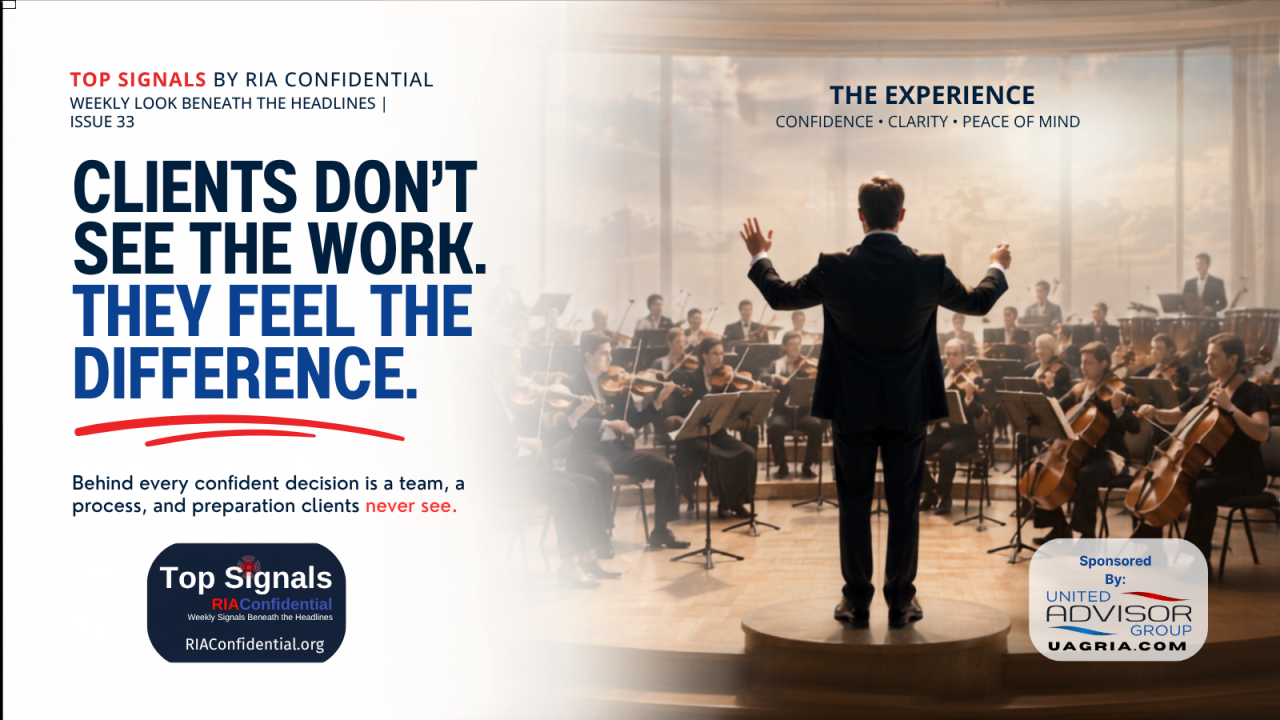
One thing kept coming back to me as I worked through this week’s signals.
Clients only see a small part of what their advisor actually does.
They see the meeting. They see the financial plan. They see the recommendation. They get the phone call when an important decision needs to be made.
What they rarely see is everything that happened before those moments.
They don’t see the portfolio review that confirmed no changes were needed. They don’t see the conversation with the CPA before tax season or the discussion with an estate attorney. They don’t see the time spent comparing strategies, thinking through tradeoffs, or asking one more question before making a recommendation.
The interesting thing is that, when advisors do this work well, it often looks like nothing happened at all.
The transition felt smooth.
The family was prepared.
A tax surprise was avoided.
A difficult conversation happened before it became a crisis.
As I read through this week’s signals, I realized they were all pointing toward the same idea:
Some of the advisor’s greatest value comes from work clients may never actually see.
Signal 1: The Work Between Meetings Still Matters
The Signal
Kitces and Carl explored what they called the “client engagement trap” — the pressure advisors can feel to remain visibly active between review meetings, even though much of their most important work happens quietly in the background.
That distinction matters.
Clients don’t usually see the account reviews, research, monitoring, preparation, or conversations happening behind the scenes. They simply experience the outcome.
When the portfolio remains aligned, the client may never know how much thought went into confirming that no change was necessary.
When a potential problem is identified early, the client may never realize there was a problem at all.
Why This Matters
The answer to the engagement challenge isn’t necessarily more meetings or more emails.
It may be helping clients understand that someone is paying attention even when everything appears to be running smoothly.
That changes the definition of visible value.
Sometimes the greatest value isn’t solving a problem.
It’s making sure the problem never reaches the client in the first place.
Who This Affects Most
Every advisory firm is affected, particularly firms trying to demonstrate ongoing value in a business model where much of the work happens outside scheduled client interactions.
What to Watch Next
How firms communicate the work happening between meetings
Greater emphasis on proactive rather than reactive service
Client experience strategies that make invisible work more tangible
Technology that helps advisors monitor and prepare without creating additional client-facing activity
Signal 2: AI Is Quietly Disappearing Into the Workflow
The Signal
Advyzon announced new AI capabilities built directly into its platform to support advisors throughout their daily workflow.
What I found interesting wasn’t the technology itself.
It was what the technology allows advisors to do.
If AI can reduce administrative work, organize information, or prepare the next step before an advisor even asks for it, the benefit is much bigger than speed.
It creates time.
Time to prepare more thoughtfully.
Time to ask better questions.
Time to spend with clients instead of software.
Why This Matters
Clients may never notice that AI helped prepare the meeting.
They’ll notice that the advisor was fully present during it.
That’s an important distinction as AI becomes embedded deeper into advisory workflows.
The most valuable use of AI may not be something clients directly interact with.
It may be everything the advisor is able to do because AI removed some of the work that previously consumed their attention.
Who This Affects Most
Independent RIAs and growing advisory firms looking to scale without allowing administrative complexity to consume more of the advisor’s time.
What to Watch Next
AI moving deeper into existing advisor workflows
More automated meeting and preparation processes
Technology designed around advisor productivity rather than client-facing novelty
Firms measuring AI success by time created for higher-value work
Signal 3: Complexity Often Hides Beneath the Surface
The Signal
Another article introduced the idea of Green, Yellow, and Red Zone clients based on personal and family complexity.
I like this way of thinking because assets rarely tell the whole story.
Two clients can have very similar portfolios while requiring completely different levels of planning, coordination, communication, and ongoing attention.
One may have a relatively straightforward financial life.
The other may have business interests, trusts, multiple generations, complicated family relationships, tax considerations, and major life decisions happening simultaneously.
The account statements may look similar.
The work required to serve them well does not.
Why This Matters
The judgment required to understand that complexity doesn’t happen during the meeting alone.
It happens beforehand.
It comes from understanding the family, the relationships, the businesses, the trusts, and the life events that rarely fit neatly into an account statement.
That preparation is difficult to measure.
It is also one of the things that can fundamentally change the client experience.
Who This Affects Most
Advisors serving affluent and complex households, particularly firms increasingly positioning themselves around comprehensive planning rather than investment management alone.
What to Watch Next
More sophisticated client segmentation based on complexity
Greater use of family and relationship mapping
Expanded coordination with outside professionals
Service models designed around complexity rather than assets alone
Signal 4: Relationships Are Built Long Before They’re Needed
The Signal
One of this week’s stories focused on building stronger relationships with the rising generation.
This is one of the easiest areas to underestimate.
The conversation you have with an adult child today may not produce any immediate business.
But five or ten years from now, it may be the reason an entire family chooses to stay together.
That relationship is built gradually.
One conversation.
One question.
One moment of trust at a time.
Why This Matters
The next generation may eventually become responsible for significant family wealth, but the relationship cannot begin when the wealth changes hands.
By then, it may already be too late.
Advisors who build relationships early are doing work whose payoff may be years away.
That doesn’t make it less valuable.
It makes it more strategic.
Who This Affects Most
Advisors serving multigenerational families and firms concerned with long-term retention, succession, and the continuity of family relationships.
What to Watch Next
More intentional rising-generation engagement
Educational conversations before wealth transfers occur
Family meetings that include multiple generations
Advisors expanding relationships beyond the primary client
Signal 5: Clients Bringing AI Into the Conversation Changes the Advisor’s Role
The Signal
Another article discussed how professionals should respond when clients arrive with AI-generated answers.
Personally, I don’t see this as a threat.
I see it as an opportunity.
Clients have always arrived with information.
Years ago it came from newspapers or television.
Then it came from Google.
Today it may come from AI.
The source keeps changing.
The advisor’s role really hasn’t.
Why This Matters
Information is easy to find.
Understanding what actually applies to someone’s life is much harder.
An AI-generated answer may be technically accurate and still be completely wrong for a particular client’s circumstances.
That’s where judgment matters.
The advisor doesn’t necessarily need to compete with AI on the amount of information available.
The opportunity is to help clients evaluate it.
What matters?
What doesn’t?
What assumptions are missing?
What happens if the situation changes?
What should the client actually do?
Those are very different questions from simply finding an answer.
Who This Affects Most
Every advisor is likely to encounter this shift as clients become more comfortable using AI to research financial, tax, estate, and investment questions.
What to Watch Next
Clients increasingly bringing AI-generated research into meetings
Advisors developing clearer frameworks for evaluating outside information
Greater emphasis on interpretation and judgment
AI becoming another source of information rather than a replacement for advice
Signal 6: Great Client Experiences Require a Great Deal of Coordination
The Signal
Another signal highlighted firms connecting workplace retirement plans with personal wealth management to create a smoother client experience.
From the client’s perspective, it may feel like one relationship.
Behind the scenes, there may be advisors, operations teams, custodians, recordkeepers, planners, compliance professionals, and technology all working together.
The client doesn’t need to see all of that.
They simply need the experience to feel connected.
Why This Matters
Coordination is one of those forms of value that can be almost completely invisible when it works well.
The client doesn’t think about which system handled the request.
They don’t think about which team member solved the operational issue.
They don’t think about how many moving pieces had to line up.
They simply feel cared for.
That’s exactly how it should be.
The better the infrastructure, the less of the infrastructure the client needs to experience.
Who This Affects Most
Growing RIAs, firms serving complex households, and advisory businesses expanding across retirement, wealth management, planning, and other adjacent services.
What to Watch Next
More integrated wealth and workplace solutions
Increased emphasis on connected client experiences
Greater investment in operational coordination
Technology designed to reduce friction across teams and platforms
Signal 7: Technology Should Protect the Advisor’s Time, Not Replace It
The Signal
Ryan Townsley’s story about growing to approximately $200 million while remaining intentionally lean was another reminder that technology works best when it gives advisors more room to be advisors.
That distinction matters.
AI and automation are often discussed in terms of how much work they can eliminate.
But the more interesting question may be what advisors can do with the time they get back.
Why This Matters
Technology’s greatest value isn’t necessarily replacing people.
It’s taking care of work that doesn’t require an advisor’s unique judgment in the first place.
If technology gives an advisor another hour to prepare for an important client conversation, coach a business owner through succession planning, or help a family navigate a difficult transition, then it is doing exactly what it should.
That’s a much more meaningful outcome than simply getting something done faster.
Who This Affects Most
Lean and growing advisory firms looking to scale while maintaining a high-touch client experience.
What to Watch Next
Firms measuring technology by time saved for advisors
Greater automation of administrative and repetitive work
AI supporting preparation and decision-making workflows
Advisory firms staying intentionally lean while increasing capacity
Editorial Note
RIA Confidential publishes Signals for informational purposes, highlighting structural patterns beneath weekly headlines. This issue is educational and is not legal, tax, compliance, or investment advice.
About RIA Confidential
RIA Confidential covers the business, regulation, and infrastructure of the RIA ecosystem, tracking capital flows, platform strategy, advisor mobility, and the operational realities of independence.
Disclosure
This publication is for informational and educational purposes only and does not constitute legal, tax, compliance, or investment advice. Readers should consult qualified professionals for advice specific to their circumstances. The investment strategy and themes discussed herein may be unsuitable for investors depending on their specific investment objectives and financial situation. Information obtained from third-party sources is believed to be reliable though its accuracy is not guaranteed. Opinions expressed in this commentary reflect subjective judgments of the author based on conditions at the time of publication and are subject to change without notice. Past performance is not indicative of future results.