For years, the industry operated on a simple assumption: technology would make advisory work easier.
And it has—at least on the surface. AI can summarize meetings, automate follow-ups, streamline data gathering, and reduce repetitive tasks across the firm.
But this week’s signals point to something more complicated.
As technology becomes more capable, the human side of advice is becoming more demanding—not less.
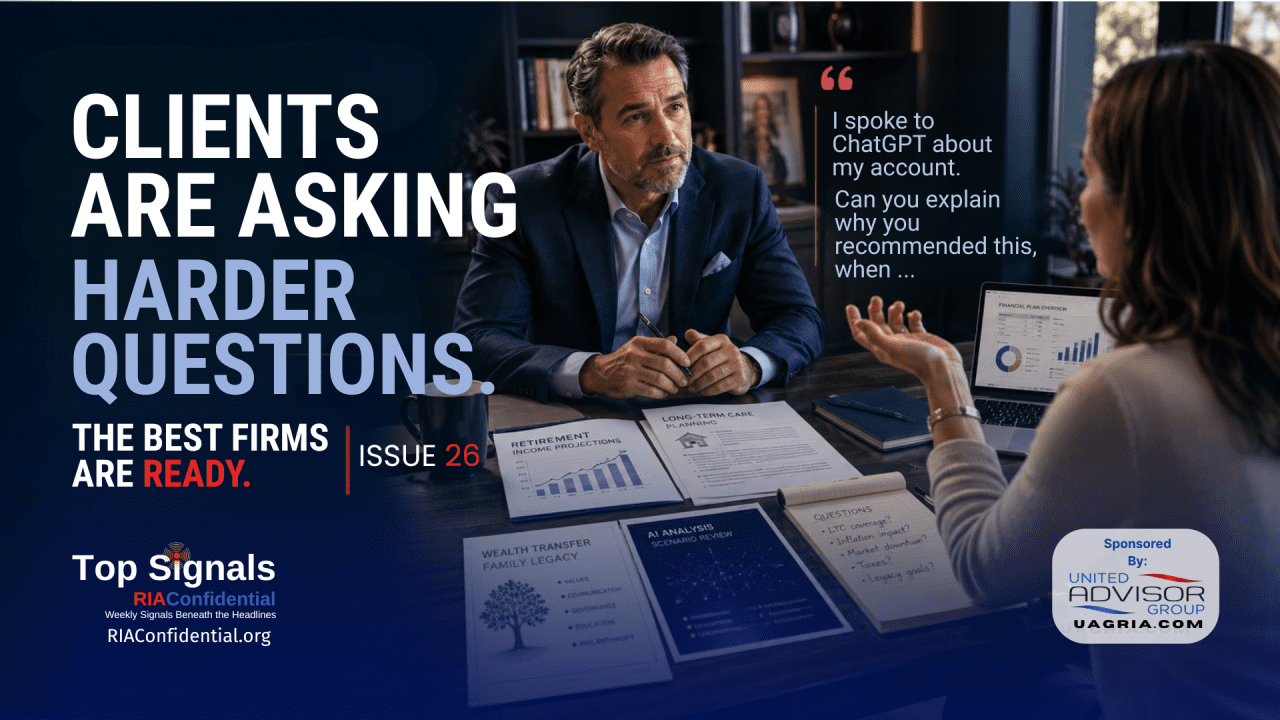
Clients are arriving with AI-generated questions. Long-term care conversations are getting more complex. Retirement is stretching longer. And wealth transfer discussions are shifting deeper into family dynamics, expectations, and decision-making—not just account structures.
Advisors are now being asked to scale two things at once: technology and humanity.
That tension is becoming one of the defining pressures of the next decade.
Signal 1: Clients are using AI to challenge advice
A growing shift in client behavior is emerging: clients are bringing AI-generated insights, questions, and critiques into planning conversations.
This does not mean the client is right. Often, the output is incomplete, overly generic, or simply incorrect.
But that is not the point.
What matters is the question behind the question.
Clients increasingly want to understand the reasoning behind recommendations. They want to see assumptions. They want to know how outcomes change when variables shift.
This raises the standard for communication inside advisory relationships.
Firms that can clearly explain the “why” behind advice will deepen trust.
Firms that become defensive risk introducing doubt where none existed.
The opportunity is to treat AI-driven questions not as challenges to authority—but as openings for better conversations.
Signal 2: AI is being used to extend advisor capacity
At the BNY INSITE conference, industry leaders highlighted a growing use case for AI: expanding advisor capacity and supporting firm scalability.
The challenge is structural. Client demand continues to rise, while advisor headcount and experience pipelines remain constrained.
AI is being positioned as a support layer—helping with meeting preparation, summaries, follow-ups, data gathering, and baseline analysis.
But the value is conditional.
Without clean data, defined workflows, and human oversight, AI does not simplify complexity—it accelerates it.
The firms that benefit most will not be the ones that “add AI.”
They will be the ones that operationalize it inside disciplined systems.
Signal 3: Most CRMs still don’t reflect how RIAs actually work
A persistent operational gap continues to surface across advisory firms: most CRM systems were not designed for planning-centric RIAs.
Many were built around sales pipelines, broker-dealer workflows, or generic contact management structures.
That mismatch creates compounding friction.
When systems cannot properly represent households, entities, family relationships, planning milestones, and service workflows, everything downstream becomes harder:
- Client service slows down
- Compliance becomes more manual
- Team coordination becomes inconsistent
- AI implementation becomes unreliable
This is often an invisible tax on the business.
And as firms move toward more automation, that tax increases.
Because automation depends on structured, accurate inputs.
If the system cannot capture reality cleanly, it cannot scale it.
Signal 4: Long-term care and disability planning is becoming more complex
Recent signals around long-term care and disability coverage highlight a growing gap between client assumptions and real-world outcomes.
Many clients assume more support exists than is actually available.
Costs are underestimated. Coverage details are misunderstood. Conversations are delayed until optionality is reduced.
This shifts planning into more personal territory.
It is no longer just about accumulation or retirement targets.
It becomes about care, housing, independence, family roles, and decision authority during periods of vulnerability.
Advisors who bring these conversations forward earlier can help clients make decisions before urgency distorts them.
Signal 5: The Great Wealth Transfer is fundamentally human
Another signal this week reinforces a growing truth: the Great Wealth Transfer is not just a financial event—it is a relational one.
When wealth moves, family systems change.
Roles shift. Expectations reset. Stewardship gets redefined. Communication gaps become visible.
The core question is no longer only “how should this be transferred?”
It becomes “what is this wealth for, and who gets to decide?”
Advisors who focus exclusively on tax efficiency, basis planning, or account logistics may miss the deeper driver of outcomes: family alignment.
The firms that step into these conversations early will be more likely to retain relationships across generations.
The Bigger Pattern
Taken together, these signals point to a clear shift.
Technology is accelerating. Advice is becoming more accessible. Systems are becoming more automated.
But client needs are moving in the opposite direction.
Toward complexity. Toward ambiguity. Toward deeply personal decisions that cannot be solved by software alone.
Longer retirements. More fragmented families. Higher expectations for clarity. More pressure around care, legacy, and decision-making.
Technology will continue to reduce friction.
But it will not reduce responsibility.
What this means for advisors
The operating questions for firms are changing:
Can your systems reflect how your firm actually serves real households?
Can your team explain the reasoning behind advice when clients bring AI-generated pushback?
Can your planning process address care, disability, and late-retirement risks early enough?
Can your client experience engage the next generation before the transfer happens?
Can your technology create more space for human work—not just more output?
These are no longer future-state questions.
They are present-day differentiators.
Bottom line
Technology will continue to embed itself deeper into advisory firms.
That trend is not in question.
The real question is whether firms use that technology to distance themselves from clients—or to go deeper into the conversations that actually matter.
Clients will not remember the dashboards.
They will remember the conversations that shaped decisions when it mattered most.
The family meetings.
The care planning discussions.
The moments of clarity during uncertainty.
The firms that win the next era will be the ones that combine better systems with better judgment—and use both to strengthen human trust.
That is where the profession is heading.
Editorial Note
RIA Confidential publishes Signals for informational purposes, highlighting structural patterns beneath weekly headlines. This issue is educational and is not legal, tax, compliance, or investment advice.
About RIA Confidential
RIA Confidential covers the business, regulation, and infrastructure of the RIA ecosystem, tracking capital flows, platform strategy, advisor mobility, and the operational realities of independence.
Disclosure
This publication is for informational and educational purposes only and does not constitute legal, tax, compliance, or investment advice. Readers should consult qualified professionals for advice specific to their circumstances. The investment strategy and themes discussed herein may be unsuitable for investors depending on their specific investment objectives and financial situation. Information obtained from third-party sources is believed to be reliable though its accuracy is not guaranteed. Opinions expressed in this commentary reflect subjective judgments of the author based on conditions at the time of publication and are subject to change without notice. Past performance is not indicative of future results.