
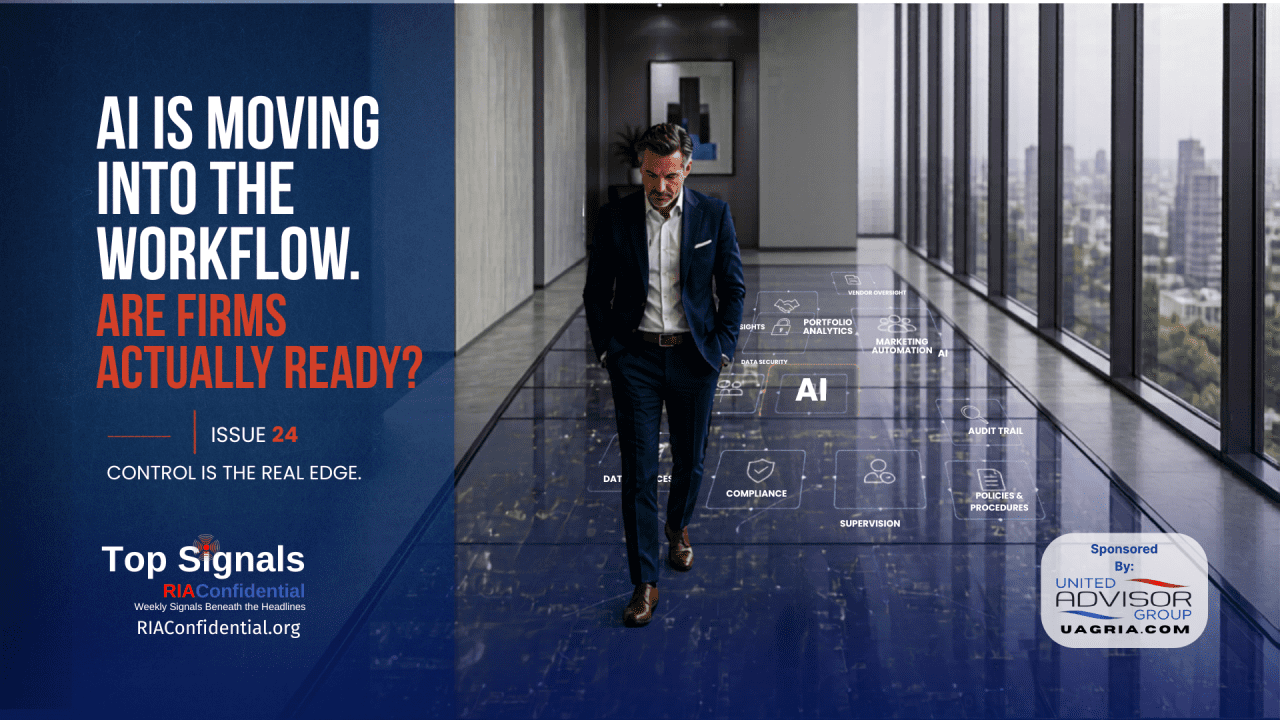
The Technology Is Advancing Faster Than Firm Infrastructure
For years, artificial intelligence sat on the edge of wealth management.
Firms experimented with it. Vendors demonstrated it. Industry conferences debated it.
Today, that phase is over.
AI is moving directly into advisor workflows. It is helping prepare for client meetings, summarize conversations, analyze data, support compliance functions, improve marketing efforts, and increasingly shape how prospective clients discover advisors online.
The technology is no longer a future consideration.
It is becoming part of the operating infrastructure of modern advisory firms.
But while adoption is accelerating, a critical question remains:
Are firms actually built to manage what comes with it?
This week’s signals point to a growing tension across the industry.
AI is expanding what firms can do.
The challenge is whether firms have the governance, processes, oversight, and client experience necessary to support it.
The firms that benefit most from AI may not be the firms using the most technology.
They may be the firms that are most prepared to manage it.
Signal #1: AI Is Moving Directly Into Advisor Workflows
Recent industry announcements continue to show AI moving deeper into day-to-day advisor operations. Envestnet has indicated that part of its investment strategy is focused on AI-driven client preparation and workflow enhancement.
Tasks that once required hours of manual work can increasingly be completed in minutes.
Meeting preparation.
Client summaries.
Data aggregation.
Research support.
Administrative follow-up.
These efficiencies are becoming embedded into the advisor experience.
Why It Matters
Efficiency is valuable.
But efficiency without accountability creates risk.
As AI-generated content becomes more common, firms must be able to answer fundamental questions:
How was this information created?
What data was used?
Who reviewed the output?
What controls are in place if something is inaccurate?
These questions are becoming operational necessities rather than compliance hypotheticals.
The more firms rely on AI-generated outputs, the more important supervision becomes.
Speed is useful.
Trust depends on oversight.
Signal #2: AI Is Entering the Alternatives Marketplace
Alternative investments continue to become more accessible to advisors and clients.
Platforms such as CAIS are incorporating AI capabilities into their ecosystems, reflecting a broader trend toward combining advanced technology with increasingly complex investment products.
Access barriers that once limited alternative investments are steadily disappearing.
Understanding them is another matter.
Why It Matters
Clients can now access sophisticated strategies more easily than ever before.
That does not mean they fully understand them.
Liquidity constraints.
Valuation complexity.
Portfolio fit.
Tax implications.
Risk characteristics.
These considerations still require thoughtful analysis and communication.
AI may help advisors explain concepts, organize information, and surface relevant data.
It cannot assume responsibility for suitability.
Ultimately, the advisor remains accountable for helping clients understand what they own and why they own it.
As access expands, client education becomes even more important.
Technology can support that effort.
It cannot replace it.
Signal #3: Marketing Is Changing Beneath Advisors
One of the most significant shifts in advisor marketing may be happening quietly.
Consumers are increasingly turning to AI-powered search experiences rather than traditional search engines alone.
Instead of scrolling through pages of results, they are asking direct questions and expecting direct answers.
This changes how expertise is discovered.
Why It Matters
The future of advisor visibility may depend less on rankings and more on relevance.
AI systems increasingly surface content that is:
Specific
Credible
Well-structured
Educational
Directly responsive to user questions
Generic marketing language becomes less effective in this environment.
Thoughtful expertise becomes more valuable.
For advisory firms, this creates a strategic challenge.
Can your content clearly demonstrate expertise?
Can your website communicate what makes your firm different?
Can your platform support the publishing and distribution of valuable insights?
As AI-driven discovery grows, visibility may increasingly belong to firms that consistently educate rather than simply promote.
Signal #4: Compliance Is Racing to Keep Pace
While AI adoption continues to accelerate, regulation remains in a period of adjustment.
Industry compliance leaders are increasingly acknowledging that technology is moving faster than formal guidance.
Many are advocating for controlled environments and firm-approved systems rather than unrestricted AI usage.
Why It Matters
The compliance conversation has shifted.
The question is no longer whether AI is being used.
The question is how it is being governed.
Firms increasingly need answers to operational questions such as:
Which tools are approved?
What data enters those systems?
How are outputs reviewed?
What documentation is retained?
Who is responsible for oversight?
These are no longer future-state concerns.
They are current operating requirements.
As AI becomes embedded in daily workflows, governance becomes a competitive advantage rather than merely a compliance obligation.
Signal #5: The Human Side Remains the Ultimate Differentiator
Amid all the discussion around technology, two client-facing trends continue to stand out.
High-net-worth families remain significantly more likely to stay with advisors who maintain relationships across generations.
At the same time, philanthropic planning conversations remain underutilized despite their importance to many affluent clients.
Both signals point toward the same reality.
Relationships still matter.
Why It Matters
AI can create capacity.
What advisors do with that capacity will determine whether it creates value.
The strongest client relationships are rarely built through efficiency alone.
They are built through conversations that matter.
Family meetings.
Next-generation engagement.
Legacy planning.
Philanthropic discussions.
Life transitions.
Moments of uncertainty.
Technology can help create the time necessary for those conversations.
It cannot have them.
The firms that win in the future will likely use AI to strengthen human relationships rather than replace human interaction.
The Bigger Pattern
Viewed together, these signals reveal something important.
AI is increasingly becoming part of advisory firm infrastructure.
Not a separate initiative.
Not a side project.
Infrastructure.
Yet technology itself is not creating the advantage.
Execution is.
Better preparation helps.
Better meetings matter more.
More access helps.
Greater understanding matters more.
More automation helps.
Better client experiences matter more.
The firms that separate themselves from competitors will not be the firms talking about AI the most.
They will be the firms quietly using it to run better businesses.
What This Means for Advisors
For advisors evaluating independence, platform choices, technology investments, or long-term growth strategies, the questions are becoming more specific.
Consider the following:
Can your firm use AI without creating compliance gaps?
Can your team confidently review and validate AI-generated outputs?
Can your marketing strategy remain visible in AI-driven search environments?
Can your client experience scale as complexity increases?
Can your operating systems support the technology being introduced?
These questions increasingly determine whether technology creates leverage or introduces risk.
The divide ahead will not be between firms that use AI and firms that do not.
The divide will be between firms that operate effectively and firms that struggle to manage increasing complexity.
Bottom Line
AI will continue moving deeper into advisory workflows.
That trend is unlikely to slow down.
The real question is not whether firms will adopt AI.
Most already are.
The question is whether they are prepared for the responsibilities that come with it.
The firms that stand out over the next decade will not necessarily be the firms with the most tools.
They will be the firms that can use those tools without sacrificing control, clarity, compliance, or trust.
As technology expands what firms can do, oversight must expand alongside it.
That is no longer a technology challenge.
It is a leadership challenge.
And increasingly, it is part of what defines a modern advisory firm.
Editorial Note
RIA Confidential publishes Signals for informational purposes, highlighting structural patterns beneath weekly headlines. This issue is educational and is not legal, tax, compliance, or investment advice.
About RIA Confidential
RIA Confidential covers the business, regulation, and infrastructure of the RIA ecosystem, tracking capital flows, platform strategy, advisor mobility, and the operational realities of independence.
Disclosure
This publication is for informational and educational purposes only and does not constitute legal, tax, compliance, or investment advice. Readers should consult qualified professionals for advice specific to their circumstances. The investment strategy and themes discussed herein may be unsuitable for investors depending on their specific investment objectives and financial situation. Information obtained from third-party sources is believed to be reliable though its accuracy is not guaranteed. Opinions expressed in this commentary reflect subjective judgments of the author based on conditions at the time of publication and are subject to change without notice. Past performance is not indicative of future results.